
Consultation Hotline
+1 (302) 618-8777
+1 (302) 618-8777
Current location:Home > Product > General Analytical Instruments > Physical Testing Instruments
PRODUCT CATEGORY
Related Articles
Detailed Introduction
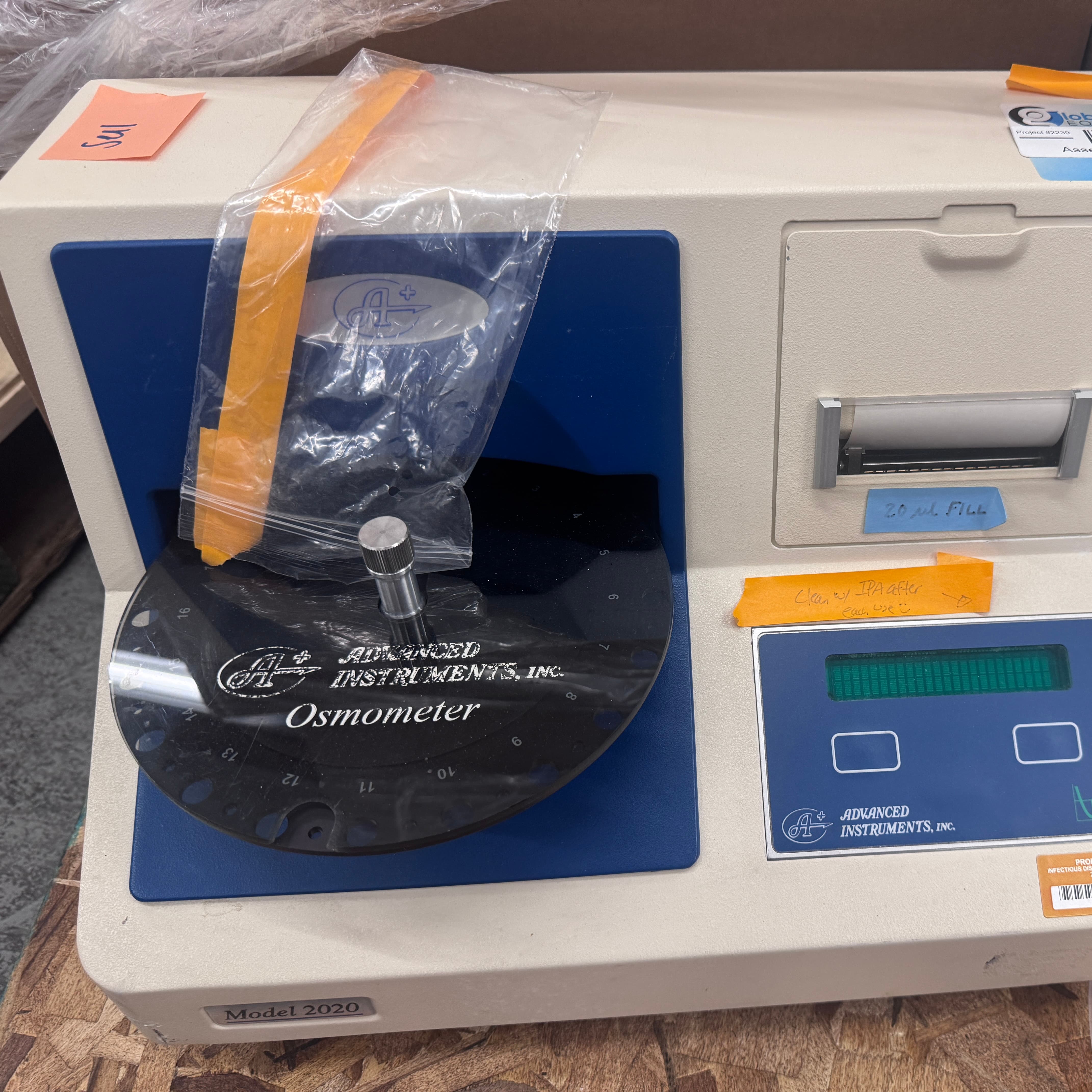
Advanced Instruments Osmometers represent the global benchmark for determining the osmolality of aqueous-based solutions, utilizing the gold-standard Freezing Point Depression (FPD) methodology. Since the company’s founding in 1955, these instruments have become the industry reference, widely recognized and mandated by major pharmacopeias (such as USP, EP, and Ph. Eur.) as well as clinical standards (like CLSI) for their unparalleled accuracy, reproducibility, and reliability. The fundamental physical principle relies on the colligative property of solutions: as solute particles are dissolved in a solvent like water, the freezing point lowers proportionally to the number of particles. Pure water freezes at 0°C, whereas a 1 osmol/kg solution freezes at approximately -1.858°C. Advanced Instruments osmometers employ a sophisticated Peltier thermoelectric cooling system to rapidly supercool the sample, followed by a controlled mechanical agitation (the "tap" method) to induce ice nucleation. A high-precision thermistor then detects the stable equilibrium temperature of the ice-water mixture, allowing the instrument to calculate and display the osmolality in milliosmoles per kilogram (mOsm/kg H₂O). This freezing point method is superior to vapor pressure techniques because it is unaffected by sample volatility or viscosity, ensuring robust performance across diverse matrices ranging from pure solvents to protein-rich biological fluids and viscous pharmaceutical formulations.
The product portfolio is strategically divided into Clinical and Bioprocessing lines to meet distinct workflow demands, yet all share the core FPD technology. For clinical diagnostics, models such as the Osmo1® (single-sample) and the OsmoPRO® series (multi-sample, up to 20 positions) are designed for high-efficiency patient testing, requiring minimal sample volumes (as low as 20 µL) and delivering results in approximately 60 to 90 seconds. These are critical for assessing hydration status, renal function, and electrolyte balance via serum, plasma, and urine analysis. For the biopharmaceutical sector, the OsmoTECH® series (including XT, PRO, and HT models) is engineered specifically for GMP/GLP environments, offering extensive data integrity features compliant with FDA 21 CFR Part 11, such as secure user access, audit trails, and LIMS connectivity. Applications here include formulation development, cell culture media optimization, and final release testing of injectable drugs to ensure isotonicity, preventing cellular damage or hemolysis. Across all models, features such as automated calibration using NIST-traceable standards, self-diagnostics, and intuitive interfaces (ranging from digital displays to full-color touchscreens) minimize operator variability and training time. The instruments are built to withstand rigorous laboratory environments, offering long-term stability with minimal drift and easy maintenance, which solidifies their status as indispensable tools in hospitals, QC labs, and research facilities globally.
Whether utilized for routine clinical pathology, complex biologics manufacturing, or food and beverage quality control, Advanced Instruments osmometers provide a critical measurement that directly correlates to solution behavior and physiological compatibility. In pharmaceutical applications, precise osmolality measurement ensures that intravenous drugs, ophthalmic solutions, and irrigants match the osmotic pressure of blood or tears, which is vital for patient safety and comfort. In research settings, it aids in studying cellular responses to osmotic stress and optimizing cryopreservation protocols for gametes and stem cells. The versatility of the sample types—encompassing biological fluids (CSF, sweat), chemical solutions (buffers, dialysates), and commercial products (beverages, dairy)—coupled with the instrument's ability to handle low-volume precious samples, makes it a universal analytical solution. By combining decades of thermodynamic expertise with modern digital connectivity and regulatory compliance, Advanced Instruments continues to lead the field of osmolality measurement, offering scientists and clinicians the confidence of accurate, defensible data essential for both diagnosis and discovery.
|
Parameter |
Specification |
|---|---|
|
Measurement Principle |
Freezing Point Depression (FPD) |
|
Measurement Range |
0 to 2000 mOsm/kg H₂O (Standard); up to 4000 mOsm/kg H₂O (Select Models, e.g., 3D3, A2O) |
|
Sample Volume |
20 µL (Micro-Osmometers, e.g., 3320, Osmo1); 20–250 µL (Standard/Single-Sample, e.g., 3D3, 3250) |
|
Test Time |
Approx. 60–90 seconds (Micro/Single); Approx. 90–120 seconds (Multi/High Range) |
|
Accuracy / Repeatability |
± 2 mOsm/kg (0–400 range); ± 0.5% (400–2000 range) (1 S.D.) |
|
Resolution |
1 mOsm/kg H₂O |
|
Calibration |
Automated, 2-point or 3-point; NIST-traceable standards (e.g., 0, 400, 1000 mOsm/kg) |
|
Operating Temperature |
18°C to 35°C (64°F to 95°F) |
|
Sample Capacity |
Single sample (e.g., 3D3, Osmo1) or Multi-sample (up to 20 positions, e.g., OsmoPRO, 2020) |
|
Data Management |
Internal memory (stores hundreds to thousands of results), USB, Ethernet, LIMS connectivity; Audit trails & Electronic Signatures (21 CFR Part 11 compliant models) |
|
Interface |
Digital Display, Resistive/Capacitive Touchscreen (model dependent) |
|
Power Requirements |
100/120 VAC or 200/240 VAC, 50/60 Hz |
|
Dimensions (Typical) |
Approx. 25–36 cm W x 38–42 cm D x 25–30 cm H (varies by model) |
|
Weight (Typical) |
Approx. 6–12 kg (13–27 lbs) |
|
Compliance |
USP, EP, Ph. Eur. 2.2.35, ASTM, CLIA, FDA 21 CFR Part 11 (select models) |
Product Inquiry