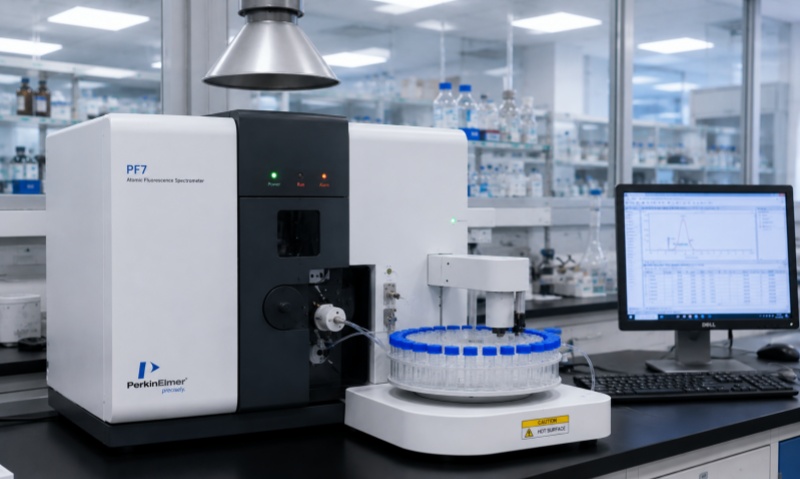
Atomic Fluorescence Spectrometer (AFS) is a precision analytical instrument widely used in environmental monitoring, food safety, geological testing and pharmaceutical analysis. It is specially applied for the trace detection of heavy metal elements such as arsenic, mercury, selenium and lead. With high sensitivity and low detection limit, the instrument plays an irreplaceable role in quantitative elemental analysis. Affected by reagent status, gas path stability, environmental conditions and daily operation habits, atomic fluorescence spectrometers often encounter typical faults such as unstable baseline, low signal intensity, poor repeatability and ignition failure. These abnormal conditions will reduce detection accuracy and interfere with experimental data judgment. This paper summarizes the common faults of atomic fluorescence spectrometers, analyzes the causes and puts forward effective troubleshooting and maintenance measures.
1. Baseline Drift and Unstable Fluorescence Signal
Baseline drift and jitter are the most frequent faults in daily testing. The main manifestations include continuous floating baseline, irregular noise spikes and unstable blank signal values. This problem is mainly caused by unstable ambient temperature, optical window contamination, and impure carrier gas. Long-term accumulation of dust and water vapor on the lens and atomizer surface will interfere with optical signal transmission and cause baseline fluctuation. In addition, unstable gas pressure and residual air in the gas path will lead to inconsistent atomization efficiency, resulting in continuous signal drift. Improper placement of hollow cathode lamps and insufficient preheating time also contribute to unstable optical signals.
To solve this fault, operators should keep the laboratory temperature and humidity stable and avoid direct air convection blowing on the instrument. Regularly clean the optical window, atomizer surface and gas pipeline to remove dust and residual liquid. Ensure the purity of carrier gas and reaction gas, and check the gas path for air leakage. Preheat the instrument and hollow cathode lamp sufficiently before testing to stabilize luminous intensity. Calibrate the baseline with blank solution to eliminate systematic drift and ensure stable signal output.
2. Low Detection Signal and Insensitive Response
Low fluorescence signal and weak detection response directly result in low sensitivity and failure to detect trace elements. The primary causes include insufficient reduction reaction, blocked capillary pipeline, aging hollow cathode lamp and contaminated atomizer. If the concentration of reducing agent is mismatched or the reagent is deteriorated, the sample cannot be fully reduced to gaseous hydride, which greatly reduces the fluorescence signal. Blocked sample capillary and peristaltic tube aging will cause unstable sample intake and insufficient atomization volume, further weakening the detection signal.
The corresponding troubleshooting methods include preparing fresh reducing agent and standard solution before batch detection to ensure chemical reaction activity. Regularly clean and dredge the sample injection pipeline, replace aging peristaltic tubes, and calibrate the sample suction volume. Check the working state of the hollow cathode lamp and replace aging lamps with decreased luminous intensity. Thoroughly clean the atomizer and gas-liquid separator to eliminate residue interference and ensure complete hydride generation and stable atomization effect.
3. Poor Data Repeatability and Large Detection Deviation
The same sample shows large deviation in repeated tests, which seriously affects the accuracy of experimental data. This fault is mainly related to unstable peristaltic pump speed, inconsistent sample preparation and incomplete gas-liquid separation. Unstable pump rotation speed causes uneven sample and reagent mixing, resulting in inconsistent reaction degree. Residual bubbles in the pipeline and incomplete gas-liquid separation will produce fluctuating impurity signals. Meanwhile, inconsistent acid concentration and contamination of sample cups will also lead to discrete test data.
Operators should calibrate the peristaltic pump regularly to ensure stable and uniform liquid feeding speed. Keep the sample preparation conditions consistent, control acidity uniformly, and avoid cross contamination of sample vessels. Exhaust pipeline bubbles before testing to ensure stable reaction and complete gas-liquid separation. Perform parallel blank tests and standard curve correction to eliminate cumulative errors and improve data repeatability.
4. Ignition Failure and Flame Abnormality
Abnormal flame or failure to ignite is a common gas path fault, mainly caused by insufficient hydrogen flow, blocked nozzle and poor ignition needle contact. Impure gas and pipeline blockage will lead to unstable gas supply, while dirt accumulation on the nozzle will block gas outflow and cause ignition failure.
The solution is to check the gas flow pressure and adjust it to the standard range, clean the nozzle and ignition needle, and remove surface carbon deposition and dirt. Inspect the gas pipeline for leakage and blockage, and ensure smooth gas supply to maintain stable flame combustion.
Conclusion
Most faults of atomic fluorescence spectrometers are caused by unstable gas path, reagent failure, pipeline blockage and insufficient daily maintenance. Standard reagent preparation, regular pipeline cleaning, stable laboratory environment and standardized operation can effectively reduce instrument failure rate. Timely troubleshooting and scientific maintenance can ensure stable instrument performance, improve detection precision and repeatability, and provide accurate and reliable data support for various trace element analysis experiments and monitoring work.