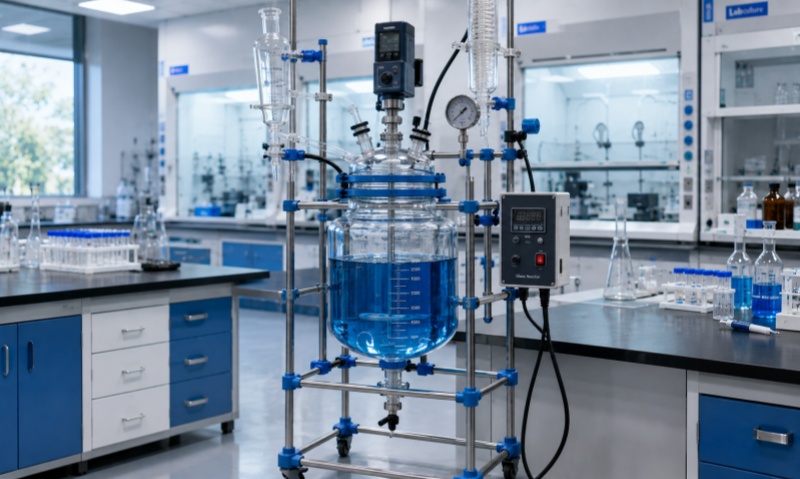
Glass reaction kettles are essential experimental and production equipment widely used in chemical synthesis, pharmaceutical manufacturing, food processing and new material research. With high borosilicate glass as the main body, the equipment features excellent corrosion resistance, light transmittance and chemical stability, which can meet the reaction requirements of various acid, alkali and organic solvents. Different from metal reaction equipment, glass reaction kettles can directly observe the real-time changes of reaction materials, crystallization state and mixing effect during operation. This article mainly introduces the working principle of glass reaction kettles and summarizes standardized maintenance and maintenance precautions to ensure stable operation and extend equipment service life.
1. Working Principle of Glass Reaction Kettle
The glass reaction kettle realizes material mixing, heating, cooling, stirring and reaction synthesis through the cooperation of mechanical stirring system, temperature control system and sealed circulation system. The equipment is composed of glass kettle body, mechanical stirrer, constant temperature circulation device, sealing assembly and feeding and discharging structure. The high transparent glass kettle body isolates the internal reaction environment from the outside world while realizing visual observation.
During operation, the mechanical stirring motor drives the stirring paddle to rotate at a uniform speed, so that the materials inside the kettle are fully mixed and convected, avoiding local concentration difference and ensuring uniform reaction. The interlayer structure of the glass kettle can circulate heating or cooling medium, which can accurately control the reaction temperature within a stable range and realize constant temperature heating, low-temperature cooling and gradient temperature adjustment. Meanwhile, the high sealing design of the kettle cover and interface can prevent volatile materials from escaping and external air from entering, which is suitable for vacuum reaction, atmospheric reaction and inert gas protection reaction.
In addition, the reserved interfaces of the glass reaction kettle can be matched with condensing devices, feeding devices and vacuum systems to complete continuous reaction processes such as distillation, reflux, concentration and purification. Relying on the stable physical and chemical properties of glass materials, the equipment will not react with most chemical reagents, effectively avoiding material pollution and ensuring the purity and accuracy of experimental and production results.
2. Daily Maintenance and Maintenance Precautions
Although glass reaction kettles have stable performance, the glass body is brittle and the supporting mechanical and sealing parts are vulnerable to wear. Standard daily maintenance is the key to reducing failures and ensuring long-term stable operation.
First, standardize operation and avoid mechanical damage. The glass kettle body shall avoid strong impact, extrusion and sudden vibration during installation, movement and use. It is forbidden to start the stirring device when the materials are too viscous or the stirring paddle is stuck, so as to prevent the stirring shaft from bending or the glass kettle body from cracking. The stirring speed should be increased gradually from low speed to avoid excessive instantaneous torque causing structural damage.
Second, strengthen cleaning and prevent residue corrosion. After each experiment and production, the residual materials inside the kettle must be cleaned completely. Different cleaning solvents should be selected according to the material properties to avoid residual crystallization and adhesion. It is forbidden to use hard tools such as steel brushes to scrub the inner wall of the glass kettle to prevent scratches. Long-term residual materials will not only affect the next experimental effect, but also cause local corrosion and hidden cracks on the glass surface.
Third, maintain sealing and transmission components regularly. The sealing ring, gasket and rotating shaft sealing parts are easy to age and deform after long-term use. It is necessary to check the sealing performance regularly and replace the aging accessories in time to avoid air leakage and liquid leakage. The transmission bearing and stirring shaft need regular lubrication maintenance to ensure flexible rotation and stable stirring operation.
Fourth, standardize temperature operation to prevent thermal damage. The glass kettle body is sensitive to sudden temperature changes. It is forbidden to perform rapid heating or rapid cooling operation in a short time. Excessive temperature difference will cause thermal expansion and contraction unevenness, resulting in glass cracking. The operating temperature must be controlled within the rated range to avoid high-temperature deformation of sealing parts and structural failure.
Conclusion
The glass reaction kettle realizes efficient and controllable chemical reaction through stirring mixing and constant temperature circulation regulation, and its transparent and corrosion-resistant characteristics bring great convenience to experimental observation and material synthesis. Good operating habits and standardized daily maintenance can effectively avoid common failures such as glass cracking, sealing leakage and unstable stirring. Scientific maintenance can not only ensure the accuracy and stability of the reaction process, but also effectively prolong the service life of the equipment, providing reliable support for laboratory research and industrial production.