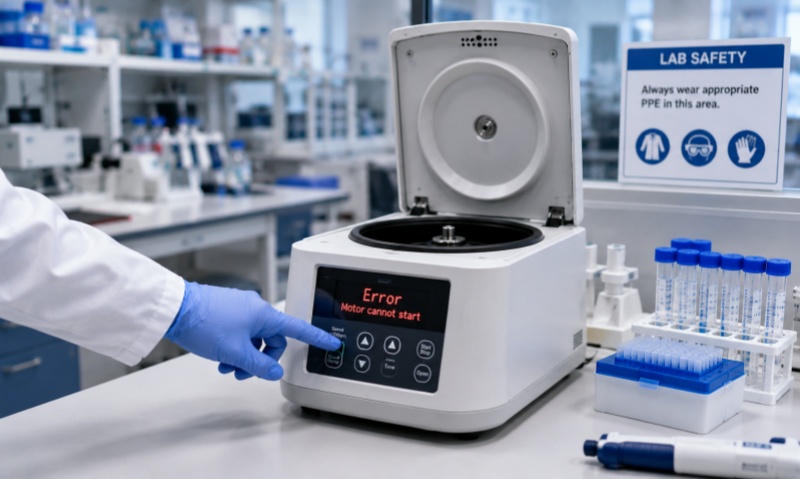
Small laboratory centrifuges are widely used in biochemical experiments, food testing, environmental analysis and routine sample pretreatment. As common precision laboratory equipment, they rely on stable motor operation to complete sample separation and stratification. In daily use, the failure that the motor cannot start normally occurs frequently. This problem will directly cause the equipment to fail to work, delay the experimental progress, and even lead to secondary component damage if not handled in time. This article systematically analyzes the common causes of motor startup failure of small centrifuges and summarizes effective troubleshooting and maintenance methods to provide technical reference for laboratory daily operation and equipment maintenance.
1. Power Supply and Circuit Abnormalities
Abnormal power supply is the most primary cause of motor startup failure. Unstable input voltage, loose power lines, damaged power adapters and poor socket contact will cut off the power supply of the centrifuge motor. In laboratory environments, frequent plugging and unplugging, aging power sockets and excessive load of power strips often result in intermittent power failure. In addition, sudden power failure and instantaneous voltage surge will trigger the equipment’s overvoltage and undervoltage protection system, causing the motor to fail to start. Internal circuit faults also account for a large proportion, including aging circuit wires, poor welding spots and short circuits caused by moisture and dust accumulation on the circuit board. When the protection circuit is triggered, the motor will be locked and unable to operate.
2. Mechanical Blockage and Rotor Stuck Failure
Mechanical jam is a key factor leading to motor startup failure. The centrifuge rotor and rotating shaft are prone to accumulate dust, sample residues and tiny debris during long-term operation. Foreign matters falling into the gap between the rotor and the cavity will cause rotor jamming. Once the rotor is stuck, the motor cannot drive the rotating structure to operate, and the equipment will present a no-start state. Meanwhile, irregular placement of centrifuge tubes, excessive sample load and unbalanced placement will cause mechanical resistance to exceed the motor load limit. The built-in overload protection device will cut off the motor power to prevent motor burnout, resulting in startup failure. Long-term static placement may also cause shaft adhesion and bearing rust, increasing startup resistance and causing startup failure.
3. Damage and Aging of Motor Core Components
The motor itself is a vulnerable component after long-term operation. Bearing aging, lubrication failure and internal wear will increase operating friction, resulting in excessive startup load and motor failure to start. Long-term high-frequency operation may cause motor coil aging, short circuit or open circuit, which directly leads to the loss of motor driving ability. In addition, the carbon brush of the brushed motor will be worn after long-term use, resulting in poor contact and failure to form a complete circuit, so the motor cannot start normally. Component aging is a natural failure problem of equipment after long service life, which is irreversible and needs professional inspection and replacement.
4. Control System and Protection Program Triggering
Modern small centrifuges are equipped with intelligent control systems and multiple safety protection mechanisms. Abnormal door lock induction, unclosed cavity door and faulty sensor signals will trigger the safety interlock program. The system will prohibit the motor from starting to avoid safety accidents. In addition, program disorder, parameter confusion and system crash caused by long-term operation will lead to wrong control instructions and motor startup failure. Overheating protection is also a common cause; if the equipment generates excessive heat during the previous operation and the temperature does not drop completely, the system will lock the motor startup function.
5. Daily Troubleshooting and Maintenance Suggestions
For motor startup failure, staff should follow the principle of external inspection first and internal maintenance later. First, check the power supply integrity and circuit stability, replace aging power accessories, and ensure normal power input. Second, clean the rotor cavity regularly to remove residual debris and foreign matters, standardize sample placement, and avoid unbalanced load. Third, maintain motor bearings regularly, supplement lubricating grease, and replace worn carbon brushes and aging components in time. Finally, operate the equipment in accordance with specifications, avoid long-time overload operation, and restart and reset the system regularly to ensure stable program operation. Standardized daily maintenance can effectively reduce motor failure rate and extend the service life of small centrifuges.