
Consultation Hotline
+1 (302) 618-8777
+1 (302) 618-8777
Current location:Home > Product > Biological Instruments > HCA Platform

PRODUCT CATEGORY
Related Articles
Detailed Introduction
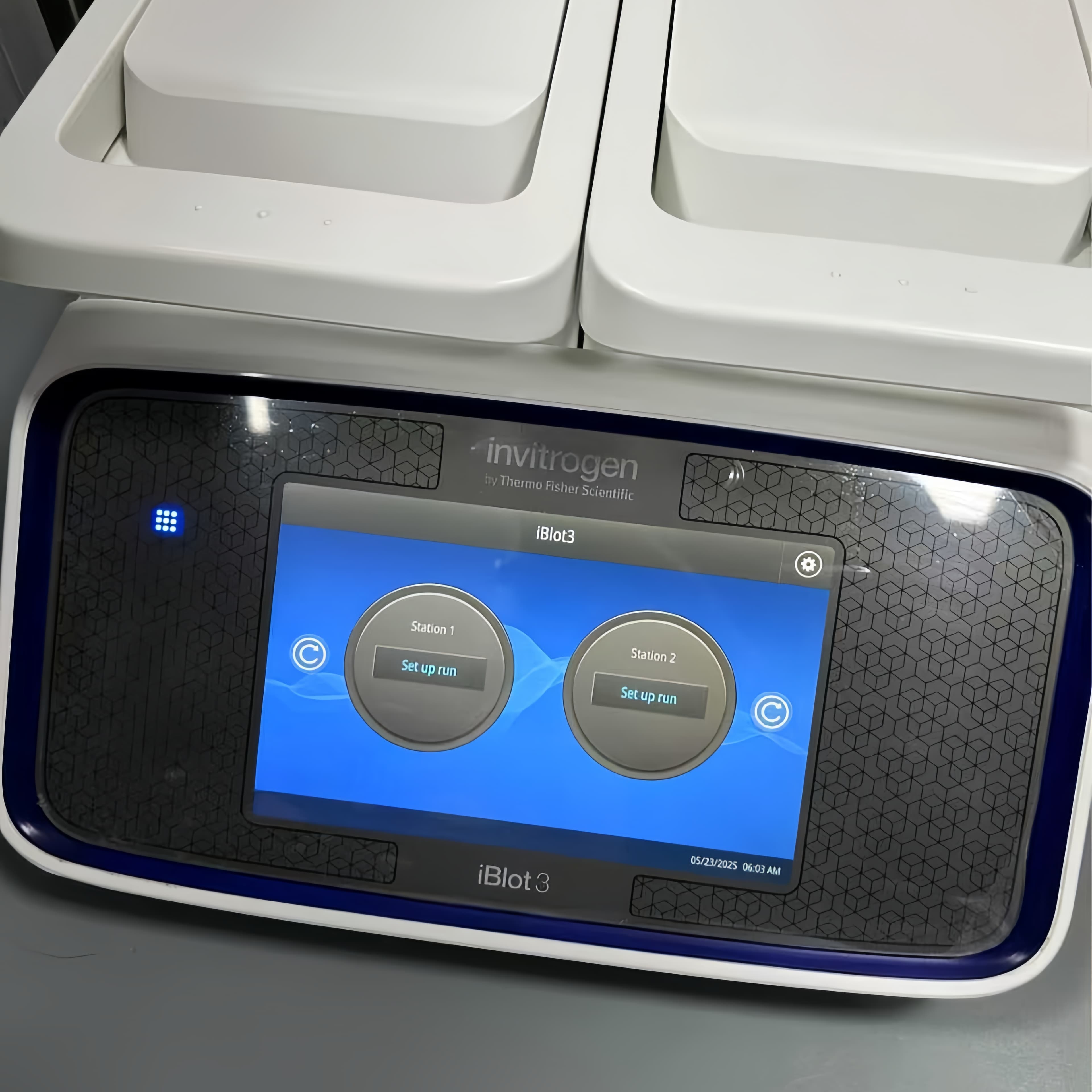
The Thermo Fisher Scientific Invitrogen iBlot 3 Western Blot Transfer Device represents the next generation of dry blotting technology, fundamentally transforming the protein transfer step of the Western blotting workflow from a cumbersome, time-consuming wet tank process into a rapid, streamlined, and highly reproducible operation. Designed for modern molecular biology, biochemistry, and cell biology laboratories, the iBlot 3 system eliminates the traditional hassles associated with preparing bulky ice packs, chilling transfer buffers, assembling complex sandwich layers with soaked filter papers, and waiting 60 to 90 minutes for a transfer to complete. Instead, this self-contained, plug-and-play instrument utilizes a sophisticated dry blotting concept powered by unique gel matrix technology housed within pre-packaged, ready-to-use transfer stacks. By integrating the power supply directly into the unit and removing the requirement for liquid transfer buffers entirely, the iBlot 3 allows researchers to achieve complete, high-quality protein transfer from polyacrylamide gels to nitrocellulose or PVDF membranes in as little as 3 minutes. This dramatic reduction in processing time, combined with a significant decrease in hands-on preparation and cleanup, maximizes laboratory productivity and enables researchers to progress to the critical immunodetection steps of their experiments much faster, making it an indispensable tool for both high-throughput screening environments and daily routine analyses in academic and biopharmaceutical research settings.
The core innovation driving the exceptional performance of the iBlot 3 lies in its advanced transfer stack chemistry and optimized electrical design. Each single-use transfer stack consists of a Bottom Stack and a Top Stack, which together sandwich the pre-run electrophoresis gel and the chosen blotting membrane (available in 0.2 µm Nitrocellulose or PVDF). The gel matrices of these stacks are impregnated with the appropriate anode and cathode buffering agents, acting as dense ion reservoirs that facilitate rapid protein migration without the need for external buffer tanks or manual pre-soaking of filter papers. A critical technical differentiator is the system's use of a copper anode, which, unlike the inert platinum or carbon electrodes found in traditional wet and semi-dry transfer systems, does not generate oxygen gas as a byproduct of water electrolysis. The generation of oxygen bubbles at the electrode interface is a known cause of blot distortion and uneven transfer in conventional methods; by eliminating this issue, the iBlot 3 ensures a highly consistent, uniform electric field across the entire gel surface. Furthermore, the physical design of the device minimizes the distance between the electrodes and incorporates an integrated power supply that delivers high field strength and current. This unique combination of gel matrix technology and electrical engineering results in transfer speeds that are exponentially faster than traditional methods, while maintaining or even improving upon the transfer efficiency for proteins across a wide molecular weight range, from small peptides to large macromolecular complexes.
Operational efficiency and user flexibility are central to the iBlot 3 design, featuring a modern, intuitive interface that caters to both novice and experienced users. The device is equipped with two independently controlled transfer stations, a significant upgrade that allows for maximum versatility in shared laboratory environments. A single iBlot 3 unit can simultaneously run two different transfer programs, accommodating up to four mini-gels (8 x 8 cm or 8 x 13 cm) or two midi-gels (13.5 x 10.8 cm) at once. This dual-station capability means colleagues can share the instrument without waiting for previous runs to finish, or a single user can process multiple gel types in one session. The user interface, typically a responsive touchscreen, provides access to multiple pre-programmed transfer methods optimized for various gel chemistries—including Tris-glycine, Bis-Tris, Tris-acetate, and Tricine—and tailored for low, high, and broad molecular weight protein ranges. Users also retain the ability to create, save, and execute custom transfer protocols to meet highly specific experimental needs. To ensure robust performance and reproducibility, the iBlot 3 incorporates a built-in adjustable cooling feature that actively manages the temperature within the transfer stations, preventing heat buildup that could otherwise denature sensitive proteins or affect transfer consistency. The physical assembly of the stack is straightforward: the user simply places the gel and membrane into the transfer stack cassette, inserts it into a station, closes the lid, and presses start. The total preparation and run time rarely exceeds 10 minutes, after which the stack is disposed of, completely removing the need for washing glass plates, cleaning reusable electrodes, or recycling large volumes of buffer.
The practical impact of the iBlot 3 system is most profound in its ability to deliver consistent, high-sensitivity, and reproducible results that match or exceed those obtained from traditional wet tank transfers. Because the transfer stacks are factory-assembled under stringent quality controls, variables introduced by manual preparation—such as unevenly soaked filter papers, trapped air bubbles in the sandwich, or incorrect buffer concentrations—are virtually eliminated. This standardization ensures that the transfer efficiency is highly uniform from run to run and user to user, a critical factor for quantitative Western blotting and comparative studies. Performance data demonstrates that the iBlot 3 achieves excellent transfer of challenging proteins, including low-abundance signaling proteins like Hsp70 and phosphorylated species like 4EBP1, with detection sensitivities comparable to or better than overnight wet transfers. The system is fully compatible with gels of standard thicknesses (1.0 to 1.5 mm) and integrates seamlessly into existing Western blotting workflows, pairing perfectly with downstream processing tools such as the Invitrogen Bandmate Automated Western Blot Processor and imaging systems like the Invitrogen iBright series. For laboratories concerned with sustainability, the copper electrodes embedded within the transfer stacks are recyclable. Altogether, the Invitrogen iBlot 3 Western Blot Transfer Device stands as a benchmark in modern protein analysis, offering a perfect synergy of speed, reliability, and ease of use that empowers researchers to focus more on data interpretation and scientific discovery rather than the technical intricacies of protein transfer.
|
Parameter |
Specification |
|---|---|
|
Instrument Name |
Invitrogen iBlot 3 Western Blot Transfer Device (System) |
|
Manufacturer |
Thermo Fisher Scientific (Brand: Invitrogen) |
|
Transfer Principle |
Dry Blotting (Buffer-free) with Gel Matrix Technology |
|
Transfer Time |
3 to 8 minutes (depending on program/gel) |
|
Transfer Buffer Required |
No (Integrated into Transfer Stacks) |
|
Capacity per Run |
1–4 Mini Gels (8 x 8 cm / 8 x 13 cm) or 1–2 Midi Gels (13.5 x 10.8 cm) |
|
Number of Stations |
2 Independently Controlled Transfer Stations |
|
Simultaneous Runs |
Yes (Two different programs can run concurrently) |
|
Compatible Gel Types |
Tris-glycine, Bis-Tris, Tris-acetate, Tricine |
|
Gel Thickness Compatibility |
1.0 – 1.5 mm |
|
Membrane Types |
Nitrocellulose (0.2 µm) or PVDF (0.2 µm) |
|
Pre-programmed Methods |
Multiple (Optimized for Low, High, Broad MW ranges & gel types) |
|
Custom Programs |
Yes (User-defined) |
|
Cooling System |
Built-in Adjustable Cooling (Active temperature management) |
|
Power Supply |
Internal (Integrated, no external power pack needed) |
|
Electrical Requirements |
100–240 V, 50/60 Hz, 6.3 A |
|
Dimensions (W x D x H) |
Approx. 44 x 30 x 18.25 cm (17.3 x 11.8 x 7.2 in) |
|
Weight |
Approx. 8.3 kg (18.3 lbs) |
|
Key Consumables |
iBlot 3 Transfer Stacks (Bottom/Top, Nitrocellulose or PVDF) |
|
Sustainability Feature |
Transfer Stack copper electrodes are recyclable |
Product Inquiry