The printed circuit board (PCB) is the core of an online gas chromatograph, handling signal acquisition, data transmission, and system control . Unlike consumable parts like columns or detectors, PCBs are often overlooked during routine maintenance. However, long-term neglect of PCB cleaning and inspection can lead to severe, often irreparable, failures that compromise both the instrument and the production processes it monitors.
1. Consequences of Long-Term PCB Neglect
Online GCs typically operate in industrial environments where dust, temperature fluctuations, humidity, and trace oil vapors are unavoidable . The accumulation of these contaminants on the PCB is not merely a cosmetic issue; it initiates a chain of damaging electrical faults.
Dust-Induced Short Circuits and Leakage
Dust and fibers accumulate on component pins, solder pads, and within slot gaps, forming a conductive layer. When combined with moisture, this layer causes micro-short circuits, leakage between traces, and stray currents. This manifests as frequent system errors, random reboots, or program freezes. In severe cases, it can cause capacitor breakdown or chip burnout, leading to total board failure and unscheduled downtime .
Signal Distortion and Communication Failures
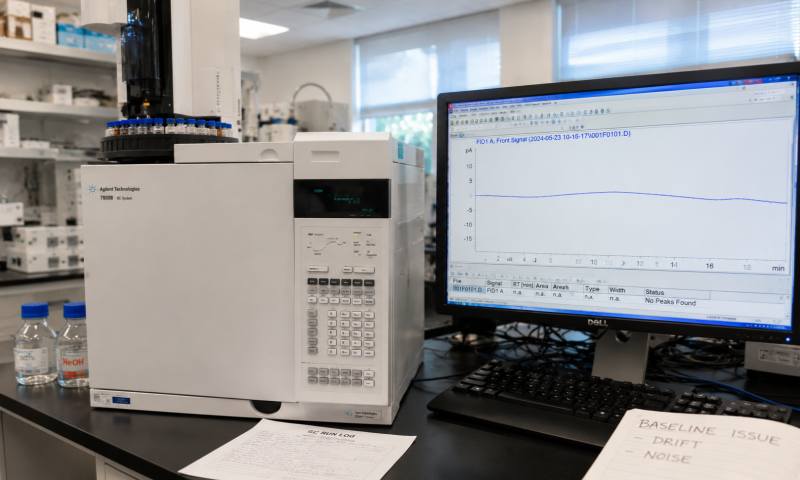
Contamination acts as a parasitic path, altering voltage levels and introducing noise. This results in erratic detector outputs, baseline drift, and inaccurate analysis data. Furthermore, oxidation of terminals and connectors due to humidity and corrosive vapors causes intermittent contact. This leads to unstable instrument communication, data upload failures, and the instrument appearing "offline" to the monitoring system .
Accelerated Component Aging and Corrosion
In environments with acidic or organic vapors (e.g., MTD or TDI), the PCB can suffer chemical corrosion. This not only damages the copper traces but also destroys the insulation resistance between components, significantly shortening the board's operational life . A contaminated board may fail due to corrosion long before its electronic components reach the end of their rated lifespan.
2. Standardized Cleaning and Purging Procedures
When a PCB is contaminated, physical cleaning is required. A standardized, methodical approach is crucial to avoid causing static damage or introducing new contaminants.
-
Preparation and Safety: Power off the instrument completely. Before handling the board, wear an anti-static wrist strap and gloves to prevent electrostatic discharge (ESD) or contamination from finger oils, which can also cause electrical leakage .
-
Initial Compressed Air Purge: Use instrument-grade air or nitrogen to purge the board and its slots. Direct the airflow at an angle and use a soft brush to gently dislodge stubborn dust from tight areas .
-
Inspection: After purging, carefully inspect the board. Look for signs of physical damage, such as burned components or corrosion on the traces and connectors .
-
Solvent Cleaning: For boards contaminated with organic residues or oil films, use a cotton swab or lint-free cloth moistened with isopropyl alcohol. Gently wipe the components and printed circuits. Pay special attention to the board's edge connectors and slot interfaces to ensure they are clean and free of oxidation .
By integrating PCB cleaning into regular maintenance schedules, facilities can prevent these catastrophic failures, ensuring the reliability and longevity of their critical analytical instrumentation.