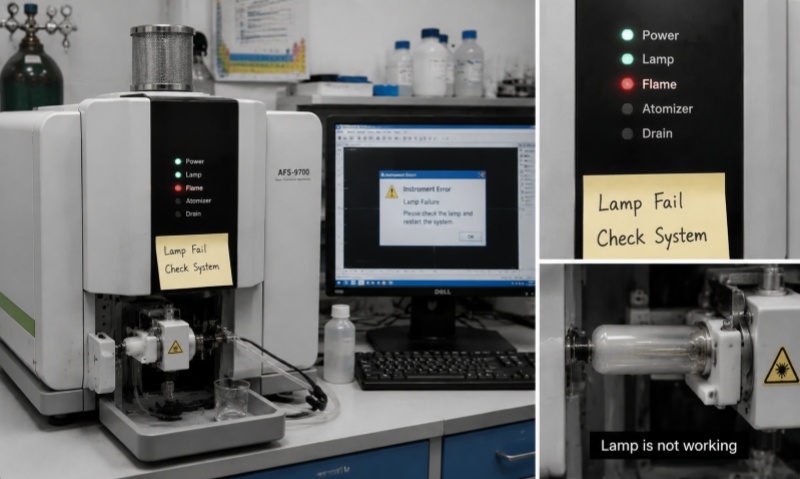
c It is widely adopted in environmental monitoring, food safety, agricultural testing, geological exploration and pharmaceutical analysis for the quantitative determination of trace arsenic, mercury, selenium, lead, cadmium and other heavy metal elements. Different from traditional atomic absorption and atomic emission spectroscopy, HG-AFS combines hydride generation chemical separation technology with atomic fluorescence detection, realizing independent and efficient analysis of trace toxic elements. This paper systematically summarizes the core application characteristics of HG-AFS and elaborates the standardized daily maintenance and maintenance specifications of the supporting instrument, so as to provide technical guidance for improving detection accuracy and extending instrument service life.
HG-AFS possesses prominent technical application characteristics that distinguish it from other analytical methods. First of all, it has ultra-high sensitivity and ultra-low detection limit. The technique realizes the separation of target elements from sample matrix through gaseous hydride generation, which effectively eliminates the interference of complex matrix components such as organic matter and metal salts in samples. Its detection limit can reach the nanogram level, which is far superior to conventional spectroscopic methods, fully meeting the detection requirements of ultra-trace heavy metals in surface water, drinking water, food and biological samples.
Secondly, HG-AFS features excellent selectivity and anti-interference ability. Each hydride-forming element has its unique excitation and emission spectral wavelength, and the instrument adopts a special optical filtering system to avoid spectral overlap and cross-interference between different elements. The gas-phase separation mode separates target analytes from liquid and solid impurities in advance, greatly reducing chemical interference and physical matrix interference. This characteristic makes HG-AFS particularly suitable for the analysis of complex samples such as sewage, soil extracts and agricultural products with miscellaneous impurity components.
In addition, the method has the advantages of fast analysis speed, low sample consumption and wide linear range. The automated hydride generation system can complete sample reaction, gas separation and fluorescence detection in a short time, with stable and repeatable detection data. Meanwhile, HG-AFS can realize simultaneous or sequential detection of multiple elements, greatly improving laboratory detection efficiency. Its linear dynamic range is wide enough to cover trace and micro-content element detection, avoiding frequent dilution and concentration operations, which effectively reduces operational errors and improves experimental accuracy.
To maintain the long-term stable operation of the HG-AFS instrument and ensure the authenticity and repeatability of detection data, standardized daily maintenance and regular maintenance are essential. The instrument maintenance mainly includes flow path system maintenance, optical system maintenance, gas path inspection, and daily environmental maintenance.
The liquid flow system is the most prone to residue and blockage, requiring daily cleaning and maintenance. After each batch of sample detection, the pipeline, reaction coil, gas-liquid separator and atomizer must be fully cleaned with ultrapure water and dilute acid solution to eliminate residual sample solution, reducing agent and acid residue. Residual chemical reagents will cause pipeline scaling, reaction tube aging and cross-contamination of subsequent samples. For long-term unused instruments, the internal flow path should be flushed and dried regularly to prevent liquid residue from breeding microorganisms and corroding pipeline components. In addition, peristaltic pump tubes are vulnerable wearing parts; regular inspection of tube elasticity and replacement of aging deformed tubes are required to ensure stable and accurate liquid feeding volume.
The optical system determines the detection sensitivity of the instrument and needs long-term dust-proof and stable maintenance. The instrument optical chamber, excitation light source and photomultiplier tube must be kept clean and dust-free at all times. The laboratory environment should be maintained dry and dust-free to prevent fine particles from adhering to lens surfaces and affecting light transmission efficiency. It is forbidden to open the optical chamber randomly during operation to avoid external light interference and dust pollution. Regular baseline calibration and blank testing are required to eliminate optical drift caused by long-term operation and ensure stable optical signal output.
Gas system maintenance is crucial to avoid detection failure. HG-AFS requires high-purity argon as carrier gas and shielding gas. Operators need to regularly check gas pipeline tightness, pressure stability and gas purity to prevent air leakage and insufficient gas pressure from affecting hydride generation and atomization effects. The gas filter and drying device in the gas path should be inspected regularly, and failed drying materials and filter elements should be replaced in time to prevent water vapor and impurity gas from entering the atomizer and interfering with fluorescence signals.
Daily environmental and systematic maintenance cannot be ignored. The instrument laboratory needs to maintain constant temperature and humidity, avoiding excessive humidity causing circuit board moisture and optical component mildew, and preventing high temperature from leading to unstable light source operation. The instrument must be equipped with a stable grounding system to eliminate static interference. Regular overall instrument calibration, blank verification and standard curve verification should be carried out to timely correct system errors and ensure detection accuracy.
In conclusion, Hydride Generation Atomic Fluorescence Spectrometry has outstanding advantages of high sensitivity, strong anti-interference, fast analysis and low matrix interference, and is an irreplaceable technical means for trace heavy metal detection. Scientific and standardized instrument maintenance is the key to maintaining instrument performance stability. Strictly implementing flow path cleaning, optical protection, gas path inspection and environmental maintenance can effectively reduce instrument failure rate, avoid data deviation caused by equipment failure, and provide accurate and reliable technical support for laboratory trace element detection and quality monitoring work.