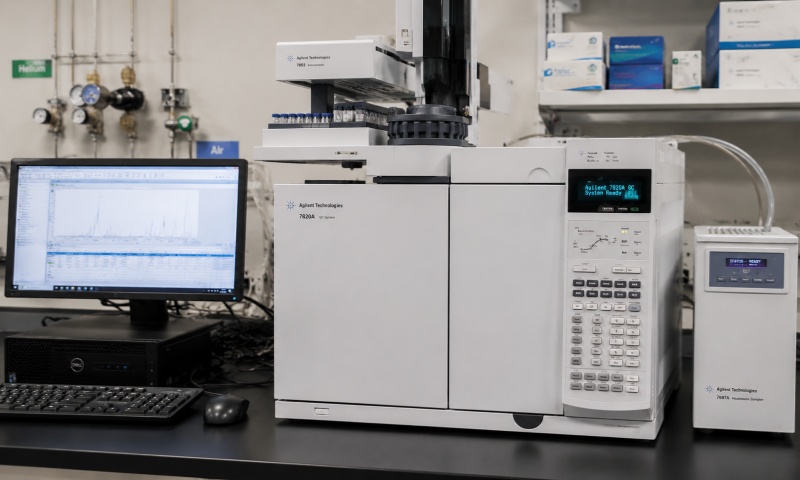
The injection system is a critical front-end component of gas chromatography (GC) instruments, responsible for accurate, quantitative, and uniform introduction of sample gas or liquid into the chromatographic column. As the initial stage of sample separation and detection, the operating state of the injection system directly determines the shape, symmetry, retention time and peak area of chromatographic peaks. Common chromatographic faults including peak tailing, fronting, splitting, ghost peaks and peak attenuation are mostly derived from injection system abnormalities such as inlet contamination, parameter mismatch and carrier gas path failure. To efficiently locate and eliminate faults and restore instrument detection accuracy, standardized three-step sequential detection procedures for injection-system-related chromatographic peak faults have been formulated, covering preliminary troubleshooting, in-depth component detection and parameter verification calibration, which provides systematic technical guidance for GC daily maintenance.
The first core detection procedure is preliminary visual and superficial state troubleshooting, aiming to eliminate simple external faults and environmental anomalies that cause peak abnormalities. This step is the foundation of rapid fault diagnosis, requiring operators to conduct overall inspection of the GC injection port and peripheral auxiliary facilities after stopping sample injection and stabilizing the instrument baseline. First, observe the real-time baseline and peak spectrum state to record fault characteristics, including whether peaks are distorted, whether baseline noise increases, and whether irregular ghost peaks appear. Second, inspect the injection port appearance and gas circuit connection status, check for loose pipeline joints, carrier gas leakage, and blocked gas filters, as tiny air leakage will cause unstable sample carrying and lead to peak distortion. Meanwhile, confirm the cleanliness of the syringe and injection liner. Residual sample residues, carbonized impurities and condensate in the liner are the main causes of peak tailing and miscellaneous peaks. In addition, verify the stability of instrument ambient temperature and gas source purity to exclude external interference factors. This preliminary detection can quickly eliminate 30% of common simple faults and clarify the general direction of subsequent in-depth inspection.
The second core detection procedure is in-depth disassembly and component performance detection of key injection system parts. If no abnormal problems are found in preliminary inspection, the fault is usually caused by internal aging, contamination or damage of core components. The key detection objects include injection liner, sealing gasket, split/splitless pipeline and needle seat. First, take out the injection liner carefully for microscopic inspection. Serious scaling, carbon deposition and crack damage of the liner will destroy the sample vaporization uniformity, resulting in peak splitting and asymmetric peaks. Contaminated liners shall be cleaned with ultrasonic organic solvent, and severely damaged ones must be replaced in time. Second, check the aging degree of inlet sealing gaskets. Long-term high-temperature operation will cause gasket deformation and air leakage, affecting the tightness of the injection system. Third, detect the unobstructed state of the split and purge pipelines to avoid pipeline blockage leading to excessive sample residue and delayed peak appearance. After component inspection, conduct simulated blank injection test without sample to observe the baseline change, which can effectively distinguish faults caused by component failure rather than sample factors.
The third core detection procedure is instrumental parameter verification and systematic calibration, which is the key to eliminating hidden parameter faults and restoring peak accuracy. Most subtle chromatographic peak faults are caused by unreasonable injection system parameter setting and drift of instrument precision parameters. First, calibrate the injection port temperature. Excessively low temperature leads to incomplete sample vaporization and peak fronting, while overhigh temperature causes sample pyrolysis and ghost peaks, so it is necessary to adjust the temperature to the optimal range matching the sample properties. Second, verify the split ratio and injection volume parameters. Unreasonable split ratio setting is a common cause of peak overload and distortion, and excessive injection volume will lead to column overload and peak broadening. Third, calibrate the carrier gas flow rate and pressure stability. Fluctuating carrier gas pressure will cause unstable sample migration and irregular peak retention time. After parameter adjustment, perform standard sample repeated injection tests, compare the repeatability, symmetry and peak area consistency of chromatographic peaks, and confirm that all fault symptoms are completely eliminated.
In practical GC analysis work, chromatographic peak faults induced by injection systems are highly repetitive and deceptive. The three-step detection procedure follows the logical principle from simple to complex, from external to internal, and from component inspection to parameter calibration, which can achieve efficient and accurate fault location and resolution. Standard implementation of these detection steps can not only quickly restore the normal working state of the instrument and ensure the accuracy and repeatability of experimental data, but also avoid long-term operation with hidden faults leading to secondary damage of injection system components. Regular fault detection and maintenance in accordance with this process can effectively improve the stability and service life of GC instruments, providing reliable guarantee for qualitative and quantitative analysis of various volatile samples.