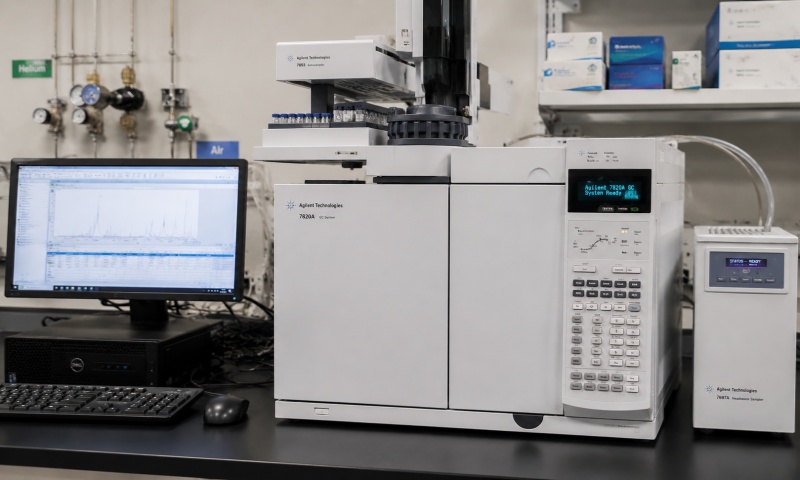
Gas Chromatography (GC) is one of the most widely used separation and analytical instruments in modern analytical chemistry. With the advantages of high separation efficiency, fast analysis speed, high sensitivity and good quantitative accuracy, it is specially designed for the qualitative and quantitative detection of volatile and semi-volatile organic compounds and partial inorganic gases. Different from high-performance liquid chromatography suitable for non-volatile substances, GC instruments rely on gas-solid and gas-liquid phase separation principles to separate target components according to differences in boiling point, polarity and adsorption capacity. Scientific application scope planning can give full play to the performance of GC instruments, standardize experimental scenarios, avoid misuse, and ensure accurate and reliable detection data in various industrial and scientific research fields.
The core application field of GC instruments is chemical and petrochemical analysis, which is the most basic and mature application scenario. In petrochemical production, GC is mainly used for component analysis of crude oil, natural gas, gasoline, diesel and various petroleum by-products. It can accurately detect the content of alkanes, olefins, aromatic hydrocarbons and residual impurities in petroleum products, evaluate product purity and combustion performance, and provide data support for petroleum fractionation, refining and quality grading. In fine chemical industry, GC is applied to detect the purity of chemical raw materials, monitor the reaction progress of organic synthesis, and analyze residual solvents in chemical products. It effectively identifies trace impurity components, controls product quality stability, and reduces unqualified product rate in industrial production.
Environmental monitoring and pollution analysis is an essential public welfare application scenario of GC instruments, undertaking the detection task of environmental volatile pollutants. In atmospheric environmental monitoring, GC is used to detect volatile organic compounds (VOCs), benzene series, formaldehyde and hydrocarbon pollutants in industrial waste gas and urban ambient air, which are key indicators of air quality assessment. In water environment detection, it can analyze volatile organic pollutants and pesticide residues in surface water and industrial wastewater, providing accurate data for water pollution control and environmental compliance assessment. In addition, GC can also detect soil volatile pollutants, realizing comprehensive monitoring of air, water and soil environmental media, and providing technical basis for environmental law enforcement and pollution remediation.
Food safety and agricultural product detection is a closely related livelihood application field of GC instruments, with strict detection standards and high application frequency. In food testing, GC is mainly used to detect residual pesticides, veterinary drugs, food additives and harmful volatile residues in grains, fruits, vegetables and processed foods. It can effectively screen toxic and harmful substances such as organophosphorus pesticides and pyrethroid pesticides, and prevent unqualified food from entering the market. In agricultural research, it analyzes the fatty acid composition of crop seeds, the aroma components of fruits and vegetables, and the volatile metabolites of agricultural products, which not only ensures food safety, but also provides data support for crop quality improvement and agricultural product optimization.
Pharmaceutical and biomedical analysis is a high-precision application scenario of GC instruments. In pharmaceutical production, GC is the mainstream detection method for residual solvent analysis in synthetic drugs, traditional Chinese medicine preparations and pharmaceutical excipients. It strictly controls the content of toxic organic residual solvents to meet pharmaceutical safety standards. In biomedical research, it is used to detect volatile metabolites in biological samples such as blood and urine, assist in clinical disease auxiliary diagnosis, and analyze the active volatile components of medicinal materials. Meanwhile, GC also plays an important role in drug stability testing and pharmaceutical production process monitoring, ensuring the safety and effectiveness of pharmaceutical products.
In addition to the above core fields, GC instruments also have extensive applications in material science, forensic identification and energy testing. In new material research, it analyzes volatile monomers and residual additives in polymer materials to evaluate material stability and safety. In forensic detection, it accurately identifies toxic gases, volatile poisons and combustible residues, providing objective evidence for judicial identification. In energy industry, it detects the component content of coal gas, biogas and new energy gases, guiding energy development and utilization.
In practical application planning, it is necessary to match instrument configuration with detection scenarios. According to different detection objects, select suitable capillary columns, detectors and temperature programming parameters, and formulate standardized detection methods. It is forbidden to use GC to detect non-volatile, thermally unstable and easily decomposed substances to avoid instrument damage and inaccurate data. Regular instrument calibration, column maintenance and gas path inspection should be matched according to application frequency to ensure long-term stable operation of the instrument.
To sum up, GC instruments cover multiple key fields such as chemical industry, environmental protection, food, medicine and scientific research, with irreplaceable application value in volatile component analysis. Reasonable application scope planning and standardized use management can maximize the detection advantages of GC instruments, ensure the accuracy and consistency of experimental data, and provide reliable technical support for industrial production quality control, environmental safety supervision, food safety guarantee and scientific research innovation.