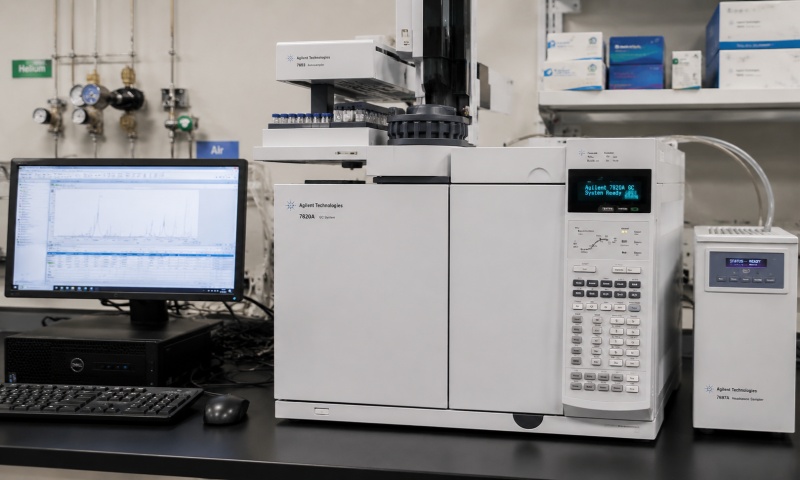
Gas Chromatography (GC) is a high-precision analytical instrument widely used in chemical testing, environmental monitoring, food safety and pharmaceutical research. Long-term continuous injection of complex matrix samples will cause accumulation of high-boiling residues, carbon deposits, grease and particulate contaminants in the split line, detectors and sampling syringes. These contaminations easily lead to common analytical faults including baseline drift, noise increase, peak tailing, poor repeatability and reduced detection sensitivity. Regular and standardized cleaning maintenance is critical to maintaining stable instrument performance, ensuring accurate experimental data and extending the service life of GC components. This article introduces professional cleaning specifications for GC split line, dual detectors of FID and TCD, and sampling syringes.
The split line is a key gas path component responsible for sample diversion and split ratio stabilization, and it is one of the most vulnerable parts to contamination. Residual high-boiling substances and decomposed impurities will adhere to the pipeline inner wall and filter screen, resulting in unstable gas flow rate and inaccurate split ratio. Before cleaning, shut down the instrument heating system, cool down the injection port and oven to room temperature, and cut off carrier gas and auxiliary gas supply to ensure operational safety. Disassemble the split filter, liner filter and connecting pipelines in sequence. For slight contamination, flush the pipeline repeatedly with chromatographic pure n-hexane or methanol to dissolve organic residues. For severe carbon deposition and stubborn dirt, low-power ultrasonic cleaning for two to three minutes is feasible to remove accumulated impurities thoroughly. After cleaning, place all parts in a dust-free environment for natural air drying, avoid high-temperature baking to prevent pipeline deformation. Reassemble components and perform 10-minute carrier gas purging to eliminate residual solvent before formal analysis.
FID and TCD detectors are core signal acquisition units with different cleaning requirements due to different working principles. The Flame Ionization Detector (FID) is prone to carbon deposition and combustion residue accumulation on nozzles and collector electrodes. After cooling and gas cutoff, disassemble the detector hood and nozzle assembly. Gently wipe the nozzle surface and electrode gap with dust-free cotton dipped in chromatographic methanol to remove carbon deposits. Use a special fine needle to dredge tiny nozzle holes to avoid blockage affecting flame stability. After assembly, set the detector temperature to 350℃ for half an hour of high-temperature baking and purging with hydrogen and air to volatilize trace impurities.
The Thermal Conductivity Detector (TCD) is highly sensitive to dirt, moisture and residual solvent, which may cause baseline fluctuation and thermal wire aging. TCD cleaning focuses on gas path dredging and moisture removal. It is forbidden to wipe the thermal wire directly to avoid deformation and breakage. Regularly purge the TCD flow cell with high-purity carrier gas at a constant temperature to take away residual moisture and micro-impurities. For severe internal contamination, replace the inlet and outlet filter tubes and conduct long-term high-temperature aging treatment to stabilize the baseline. Different from FID, TCD requires stricter drying and purging standards to prevent trace solvent from affecting thermal conductivity balance.
GC micro syringes are precision sampling tools, whose cleanliness directly determines sampling accuracy and avoids cross-contamination. Residual samples and high-boiling impurities often remain in the needle tube and needle tip gap. For daily conventional samples, rinse the syringe 3 to 5 times with matched chromatographic solvents after each injection. Use methanol for water-soluble samples and n-hexane for fat-soluble organics to achieve polar matching and thorough elution. For high-viscosity and high-boiling complex samples, perform gradient cleaning: flush with low-polarity solvent first, then conduct short-time low-power ultrasonic cleaning to remove stubborn residues. Wipe the needle tip gently with dust-free filter paper and dry naturally. It is strictly prohibited to use high-frequency ultrasonic cleaning or violent extrusion to prevent needle rod deformation and damage.
In summary, regular cleaning of GC split line, dual detectors and syringes is an essential part of laboratory instrument daily maintenance. Targeted cleaning operations for different components can effectively eliminate baseline noise, peak distortion and cross-contamination problems caused by dirt accumulation. Standardized maintenance can not only ensure the stability and accuracy of GC analytical results, but also reduce component loss and instrument failure rate, providing reliable technical support for long-term laboratory quantitative and qualitative analysis work.