Consultation Hotline
+1 (302) 618-8777
+1 (302) 618-8777
Current location:Home > Blogs > Industry News
Agilent Technologies Highlights Analytical Innovation, Instrument Performance, and Workflow Efficiency
SANTA CLARA, Calif. — Agilent Technologies continues to advance analytical laboratory capabilities through its portfolio of mass spectrometry and chromatography technologies. Among the featured systems are the Agilent 9500 Triple Quadrupole ICP-MS, the Agilent 8890B and 8860B Gas Chromatography Systems, and the fluorescence detector designed for the Agilent 1290 Infinity III LC platform. These technologies address a broad range of analytical requirements, from trace elemental analysis and routine gas chromatography to advanced liquid chromatographic detection.
As laboratories face increasingly complex analytical challenges, instrument manufacturers are focusing on sensitivity, selectivity, reproducibility, automation, and data quality. Agilent’s analytical technologies are designed to support researchers and laboratory professionals working in environmental testing, pharmaceutical development, chemical analysis, food safety, materials science, and other fields.
Inductively coupled plasma mass spectrometry (ICP-MS) is widely used to determine trace and ultratrace concentrations of elements in complex samples. Applications include environmental monitoring, semiconductor materials analysis, pharmaceutical quality control, food testing, and industrial process monitoring.
The Agilent 9500 Triple Quadrupole ICP-MS is positioned for laboratories requiring advanced elemental analysis and improved control over spectral interferences. Triple-quadrupole ICP-MS technology uses multiple quadrupole stages and a reaction or collision cell to help distinguish target analytes from interfering species.
In conventional elemental mass spectrometry, polyatomic ions and other spectral interferences can overlap with the signals of elements of interest. These interferences may complicate measurements when samples contain complex matrices or when target elements are present at very low concentrations.
A triple-quadrupole configuration provides additional control over ion selection before and after the reaction cell. When combined with suitable reaction chemistry and validated analytical methods, this approach can help improve selectivity for challenging elemental measurements.
Potential applications include the determination of trace metals in water, analysis of high-purity materials, monitoring of elemental impurities in pharmaceutical products, and characterization of industrial materials.
For laboratories evaluating an ICP-MS platform, important selection criteria include detection limits, interference control, sample throughput, matrix tolerance, operating costs, and the availability of validated methods for the intended application.
Gas chromatography remains an essential analytical technique for separating and measuring volatile and semivolatile compounds. It is commonly used in petrochemical analysis, environmental monitoring, food testing, fragrance analysis, chemical manufacturing, and pharmaceutical research.
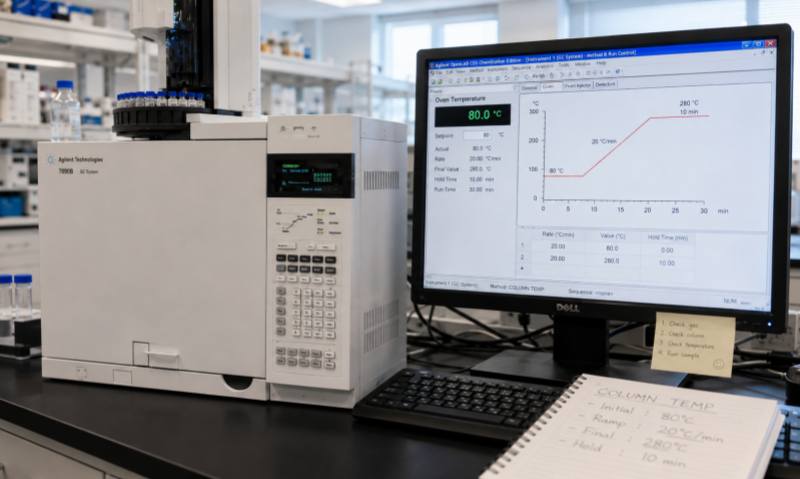
The Agilent 8890B and 8860B Gas Chromatography Systems serve laboratories with different analytical and operational requirements.
The 8890B platform is designed to support advanced GC workflows, with configuration options for different inlets, detectors, sample introduction systems, and automated analytical methods. Depending on the selected configuration, laboratories can develop methods for complex mixtures, routine quality-control testing, and applications requiring higher levels of automation.
The 8860B platform focuses on accessible, reliable gas chromatographic analysis for routine laboratory applications. Its configuration and operating workflow can suit laboratories that prioritize repeatable results, straightforward operation, and efficient execution of established analytical methods.
Both platforms can be configured for different applications, depending on detector selection, column chemistry, sample introduction requirements, and method parameters.
Laboratories can use gas chromatography to separate individual compounds within complex samples and measure their concentrations against established calibration standards. Appropriate method development and quality-control procedures remain essential for obtaining reliable results.
When selecting between GC systems, laboratories should consider sample volume, the complexity of the analytical method, required detectors, autosampler compatibility, software requirements, and long-term maintenance costs.
High-performance liquid chromatography (HPLC) and ultra-high-performance liquid chromatography (UHPLC) are widely used to separate, identify, and quantify compounds in complex samples.
Fluorescence detection can provide high sensitivity and selectivity for compounds that naturally fluoresce or can be converted into fluorescent derivatives. It is particularly useful in applications where ultraviolet absorbance detection may not provide sufficient selectivity or sensitivity.
The fluorescence detector for the Agilent 1290 Infinity III LC platform is intended to support advanced liquid chromatographic workflows. By measuring emitted fluorescence at selected wavelengths following excitation, the detector can help analysts distinguish target compounds from other sample components.
Potential applications include pharmaceutical analysis, impurity profiling, food testing, environmental analysis, and research involving fluorescent compounds or labeled biomolecules.
Detector performance depends on several factors, including excitation and emission wavelengths, mobile-phase composition, sample properties, background fluorescence, and chromatographic separation conditions. Appropriate method development is therefore necessary to establish sensitivity, specificity, and quantitative reliability for each application.
When integrated into a compatible LC configuration, fluorescence detection can complement other detection technologies and expand the range of compounds that laboratories can analyze.
Modern laboratories increasingly require analytical instruments that can fit into established workflows while supporting dependable data collection and efficient routine operation.
Mass spectrometry and chromatography provide complementary analytical capabilities. ICP-MS measures elemental composition, gas chromatography separates volatile compounds, and liquid chromatography supports the separation of less volatile or thermally sensitive substances.
Together, these techniques address diffe