Consultation Hotline
+1 (302) 618-8777
+1 (302) 618-8777
Current location:Home > Blogs > Industry News
New collaboration combines advanced analytical instrumentation and interdisciplinary science to accelerate next-generation energy storage research
CHICAGO and SANTA CLARA, Calif., October 27, 2026 — Agilent Technologies Inc. and the University of Chicago have announced a scientific collaboration to establish the Agilent Center of Excellence (CoE) for Energy Materials Research. Based at the University of Chicago Pritzker School of Molecular Engineering (UChicago PME), the new center aims to strengthen research into next-generation energy storage materials and support the development of more efficient, reliable, and sustainable battery technologies.
The initiative brings together Agilent’s analytical instrumentation and application expertise with the University of Chicago’s interdisciplinary research capabilities. The center will support the university’s Energy Technologies Initiative (ETI), a partnership between UChicago PME and the University’s Institute for Climate and Sustainable Growth that promotes innovation in energy storage through academic research and industry collaboration.
Energy storage has become an increasingly important area of scientific and technological development. Batteries are essential to electric vehicles, portable electronic devices, renewable energy integration, and large-scale electricity storage. As demand for these applications grows, researchers face challenges in developing materials that deliver improved performance, longer service life, greater safety, and more sustainable production.
Addressing these challenges requires a detailed understanding of how materials behave under different operating conditions. Researchers must investigate chemical composition, trace impurities, material interfaces, structural changes, and degradation pathways that can influence battery performance over time.
The Agilent Center of Excellence is designed to help researchers access advanced analytical capabilities within the research environment where these questions are being investigated. By combining instrumentation, method development, and interdisciplinary collaboration, the center will support more comprehensive investigations of energy storage materials and systems.
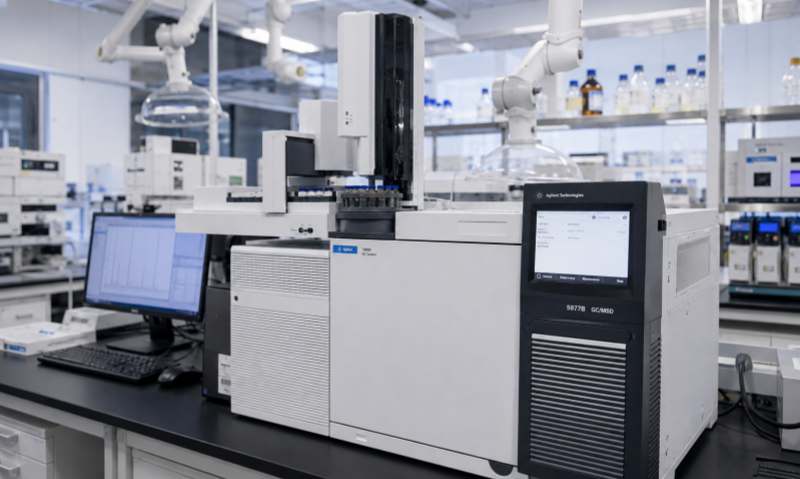
The center will use Agilent instrumentation, including mass spectrometry and atomic spectroscopy, to help scientists investigate the materials and chemical systems used in next-generation batteries.
Mass spectrometry can provide detailed information about chemical composition and molecular species, helping researchers examine complex materials and chemical changes associated with energy storage. Depending on the analytical method and sample type, these capabilities can support investigations of electrolyte components, degradation products, and other chemical species relevant to battery research.
Atomic spectroscopy provides complementary capabilities for elemental analysis. Accurate measurement of elemental composition and trace contaminants can help researchers assess material purity, identify impurities, and investigate the distribution of elements in battery-related materials.
Together with suitable sample preparation procedures, analytical methods, and data interpretation workflows, these technologies can provide complementary information about the chemical properties of materials used in energy storage systems.
The center will also support the development of analytical methods and workflows tailored to research needs. This approach is intended to help investigators address specific scientific questions rather than relying solely on individual instrument capabilities.
The Agilent Center of Excellence will support collaboration among researchers across the University of Chicago and with other academic and industry partners through the Energy Technologies Initiative.
Interdisciplinary research is particularly important in battery science because advances often depend on integrating chemistry, materials science, molecular engineering, computation, and device-level testing. Bringing these areas together can help researchers connect observations at the material level with broader questions about battery operation and durability.
The collaboration will expand access to advanced analytical tools for researchers across the university. It will also create opportunities for faculty members, students, and research trainees to work together on energy storage challenges and develop expertise in analytical characterization.
According to Agilent Applied Markets Group President Mike Zhang, combining the university’s interdisciplinary strengths with Agilent’s instrumentation and application expertise will provide researchers with greater capabilities to investigate complex materials and address challenges in battery and materials science.
The establishment of the center also reflects the importance of collaboration between instrument manufacturers and academic institutions. Instrument manufacturers contribute analytical technologies and application knowledge, while university researchers contribute fundamental scientific questions, experimental expertise, and materials discovery capabilities.
One of the central challenges in battery research is understanding how materials change throughout a battery’s operating life.
Battery performance can be affected by chemical reactions, contamination, interfacial changes, and the gradual degradation of active materials. These processes may influence energy capacity, charging behavior, operational stability, and safety.
Advanced analytical techniques can help researchers identify chemical changes and investigate potential degradation mechanisms. Such information can guide the evaluation of new materials, inform experimental design, and support the development of improved battery formulations.
The center will provide researchers with additional capabilities to investigate degradation in energy storage and energy conversion materials and devices. These investigations may contribute to a deeper understanding of the relationships between material composition, chemical stability, and long-term performance.
The work is relevant to multiple energy storage applications, including batteries for electric transportation, connected devices, and grid-scale energy systems. However, the practical impact of any research finding will depend on the materials studied, the experimental methods used, and subsequent validation.
Sustainability is another important consideration in the development of next-generation batteries. Many existing battery technologies rely on critical minerals and other materials that can be expensive to obtain, difficult to process, or challenging to recycle.
Researchers are therefore investigating alternative material systems, including approaches that could reduce dependence on scarce resources and improve the environmental profile of energy storage technologies.
At UChicago PME, research includes exploration of organic battery materials that could offer alternative pathways for energy storage by using more abundant elements. The center’s analytical capabilities may help researchers characterize these materials and investigate their behavior during energy storage and conversion.
Better analytical understanding can support the evaluation of alternative materials, although commercial viability will also depend on factors such as electrochemical performance, manufacturing requirements, durability, cost, and recyclability.
By supporting fundamental research and method development, the collaboration aims to contribute to the broader scientific effort to develop more sustainable energy technologies.
The launch of the Agilent Center of Excellence for Energy Materials Research represents a new step in the collaboration between Agilent and the University of Chicago. By bringing advanced analytical instrumentation into an interdisciplinary research setting, the initiative is intended to strengthen the tools available to scientists studying energy storage materials.
The center will support the Energy Technologies Initiative by connecting researchers, analytical capabilities, and application development. Its work will focus on improving the ability to characterize complex materials, investigate degradation mechanisms, and generate scientific information relevant to next-generation battery development.
As demand for reliable energy storage continues to grow, collaborations between academic institutions and technology companies will remain an important part of the research landscape. The new center provides a framework for bringing together scientific expertise and analytical technology to investigate some of the most challenging questions in battery and materials science.
Agilent Technologies Inc. (NYSE: A) provides analytical and clinical laboratory technologies, including instruments, software, services, and application expertise. Its solutions support scientific research, diagnostics, pharmaceutical development, chemical analysis, and other laboratory applications worldwide.
The University of Chicago Pritzker School of Molecular Engineering integrates science and engineering to address major global challenges. Its research spans areas including quantum science and engineering, immunoengineering, bioengineering, and sustainable materials, including energy storage and clean water technologies.
For more information, visit pme.uchicago.edu.
The Energy Technologies Initiative advances energy storage technologies through fundamental research and industry partnerships. It is one of the central initiatives of the University of Chicago’s Institute for Climate and Sustainable Growth and is anchored at the Pritzker School of Molecular Engineering.
For more information, visit energytech.pme.uchicago.edu.
Source: Agilent Technologies and the University of Chicago, official announcement published October 27, 2026.