Consultation Hotline
+1 (302) 618-8777
+1 (302) 618-8777
Current location:Home > Blogs > Industry News
August 13, 2026 — Bruker Corporation has announced an expanded strategic collaboration with Atinary Technologies, a developer of Self-Driving Laboratory (SDL) technologies and AI-driven research and development platforms. As part of the expanded partnership, Bruker has also made a minority investment in Atinary. Financial terms of the investment were not disclosed.
The agreement marks another significant step in the convergence of analytical instrumentation, laboratory automation, scientific software, and artificial intelligence. Rather than treating AI as an isolated software assistant, the partnership aims to connect AI-based experimental planning directly with automated laboratory execution and analytical measurement, creating a closed-loop R&D workflow.
Traditional laboratory automation primarily focuses on executing predefined procedures. Robots can dispense reagents, prepare samples, run reactions, and transfer materials, but the experimental strategy generally remains under human control.
Self-Driving Laboratories take this concept further. AI systems can evaluate experimental results, identify promising conditions, design subsequent experiments, and send instructions back to laboratory automation equipment. The resulting cycle creates a continuous loop in which every experiment generates data that informs the next experiment.
Atinary's SDLabs platform is designed around this concept. According to Bruker, scientists can use AI agents to design experiments, explore molecular spaces, execute laboratory runs, visualize and interpret results, and generate recommendations for subsequent experiments.
The strategic collaboration therefore focuses on turning laboratory automation into a more autonomous scientific discovery infrastructure.
For Bruker, the investment aligns with a broader strategy of combining analytical technologies with laboratory automation, scientific software, and AI-guided experimentation.
Bruker already has extensive capabilities in analytical instrumentation, including nuclear magnetic resonance (NMR), mass spectrometry, and other characterization technologies. The company's Chemspeed automation activities and SciY scientific software capabilities provide additional components for building digitally connected laboratories.
Bruker said its strategic investment in Atinary advances its objective of combining differentiated analytical technologies with laboratory automation, scientific software, and AI-guided experimentation. The company also highlighted existing Self-Driving Lab workflows in Basel and Boston.
This combination could allow analytical instruments to become active components in autonomous research rather than simply endpoints that generate data after an experiment has been completed.
One example highlighted by Bruker integrates Chemspeed robotics, a Bruker Fourier 80 FT-NMR system, and Atinary's SDLabs agentic AI platform.
Within this workflow, automated systems can handle reagent addition, catalyst addition, reaction execution, sampling and filtration, while NMR analysis provides analytical feedback. The AI platform can then use experimental results to guide subsequent experiments. The system has been demonstrated across chemical reactions including Suzuki and Buchwald-Hartwig chemistry.
The significance of this architecture lies in the feedback loop.
Instead of following a fixed sequence of experiments, the system continuously connects experiment design → robotic execution → analytical measurement → data interpretation → AI recommendation → next experiment.
Such an architecture could substantially reduce the time required to explore large experimental parameter spaces.
The technology has potential applications across pharmaceuticals, chemicals, energy, and advanced materials. These industries frequently require researchers to investigate large numbers of combinations involving molecular structures, catalysts, solvents, temperatures, concentrations, reaction times, and processing conditions.
Traditional experimental workflows can become slow and resource-intensive as the number of variables increases. AI-guided experimentation offers a potential alternative by prioritizing experiments that are expected to generate the most useful information.
Importantly, the objective is not simply to perform more experiments. The goal is to make each experimental cycle more informative and use the resulting data to improve subsequent decisions.
This approach is particularly attractive for materials and chemistry research, where the relationship between composition, processing conditions, structure, and performance can be extremely complex.
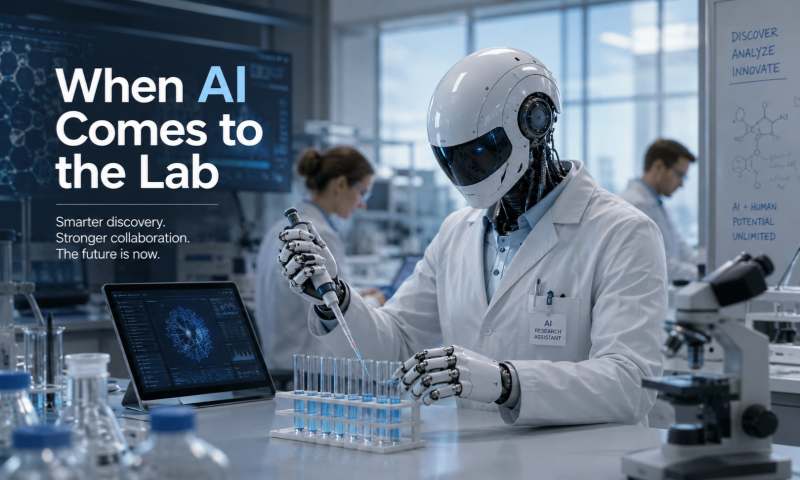
Bruker's investment also reflects a broader industry shift toward the "AI laboratory." In this emerging model, laboratory robots provide the physical execution layer, analytical instruments generate structured experimental data, and AI systems provide decision-making and optimization capabilities.
Recent developments across the industry indicate growing competition to build the software and automation infrastructure required for self-driving laboratories. Atinary has positioned its platform as an AI orchestration layer connecting laboratory automation, analytical instruments, data, and experimental decision-making.
The challenge, however, is considerable. Autonomous laboratories must integrate equipment from different manufacturers, handle experimental uncertainty, maintain reliable data pipelines, and ensure that AI-generated recommendations remain within scientifically and operationally safe boundaries.
The most important long-term opportunity may be the creation of an R&D "flywheel." Each experimental cycle generates new data, which improves the understanding of the research problem and influences the next round of experiments.
Over time, this could transform laboratory research from a largely linear process into an adaptive system.
Researchers would increasingly focus on defining scientific objectives, evaluating AI-generated strategies, interpreting unexpected results, and making higher-level decisions, while repetitive experimentation and optimization could be delegated to autonomous systems.
Bruker and Atinary's expanded collaboration represents a significant move in this direction. By combining Bruker's analytical instrumentation, Chemspeed laboratory automation, SciY scientific software, and Atinary's agentic AI capabilities, the companies are seeking to create a more integrated foundation for autonomous R&D.
As AI moves from assisting scientists to actively planning and optimizing experiments, the laboratory itself could become an intelligent closed-loop system. Bruker's investment in Atinary signals that the next phase of scientific instrumentation may not simply be about producing better measurements—it may be about connecting those measurements directly to autonomous decisions and the next experiment.
If successful, this model could accelerate discovery while reducing repetitive experimental work and provide researchers with a fundamentally different way to explore complex chemical and materials spaces.