Consultation Hotline
+1 (302) 618-8777
+1 (302) 618-8777
Current location:Home > Blogs > Industry News
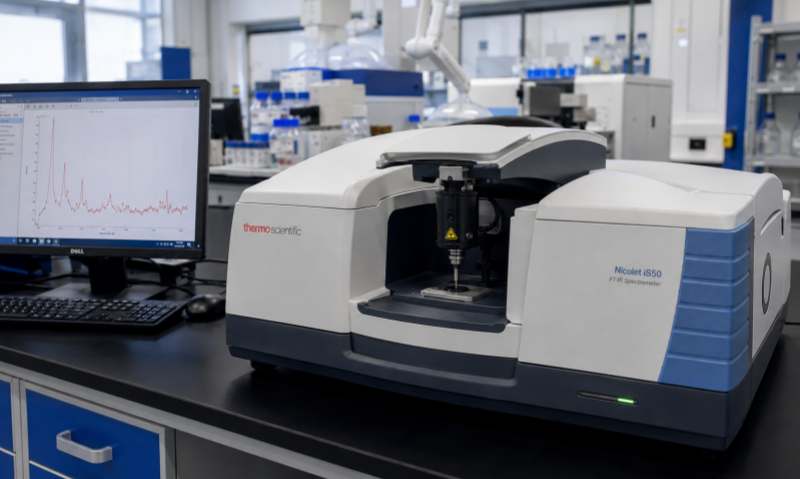
Near-Infrared Spectroscopy (NIR) is a rapid, non-destructive analytical technique that generally covers the wavelength range of approximately 800–2500 nm. Compared with mid-infrared spectroscopy, NIR absorption mainly originates from overtone and combination vibrations of molecular bonds. Although NIR bands are relatively broad and chemically less selective, the technology offers strong penetration, fast measurement, minimal sample preparation, and excellent potential for online and at-line analysis. As a result, NIR has become increasingly important in pharmaceuticals, food, agriculture, chemicals, polymers, semiconductor materials, and process analytical technology.
It is important to note that the performance of an NIR spectrometer cannot be judged solely by its wavelength range or spectral resolution. Light source stability, optical design, detector performance, sampling accessories, temperature control, chemometric models, and long-term instrument stability all contribute to analytical performance. The following section provides an in-depth overview of five representative international NIR brands, with a focus on their technical characteristics, application strengths, and common troubleshooting issues.
Ocean Optics is a well-known international brand in the field of optical spectroscopy, particularly recognized for its miniature spectrometers, OEM integration capabilities, and portable analytical solutions. Its NIR product portfolio includes a variety of systems covering the NIR region, such as the Ocean NR, NIRQuest, and ST-NIR series.
One of Ocean Optics' key strengths is its emphasis on compact design, flexible configuration, and system integration. Its NIR solutions can be combined with different light sources, optical fibers, probes, sampling accessories, and software platforms, allowing users to build customized spectroscopy systems for specific applications.
The ST-NIR series, for example, focuses on ultra-compact NIR spectroscopy and is suitable for OEM instruments, materials characterization, plasma monitoring, and applications where installation space is limited. Other NIR platforms emphasize sensitivity, low noise, and improved temperature stability.
Rather than focusing exclusively on large laboratory instruments, Ocean Optics has developed a strong ecosystem around the concept of “spectrometer + light source + fiber + sampling accessory + software.” This makes the brand particularly attractive for portable analysis, online monitoring, research and development, and secondary instrument integration.
Typical applications: Materials analysis, semiconductor and energy materials, food and agriculture, pharmaceuticals, biotechnology, environmental monitoring, and OEM integration.
Overall rating: ★★★★★
Bruker has extensive experience in infrared, Raman, and vibrational spectroscopy. Its NIR portfolio primarily follows the FT-NIR technology route and includes solutions for laboratory analysis, at-line testing, and process control.
Bruker's FT-NIR platforms are designed for applications in pharmaceuticals, food, agriculture, chemicals, and industrial quality control. A major advantage is the combination of advanced spectroscopic technology with chemometric analysis and application-specific solutions.
For pharmaceutical and food manufacturers, NIR can significantly reduce analysis time and consumables compared with conventional wet chemistry methods. Multiple physical and chemical parameters can potentially be analyzed from a single measurement.
However, FT-NIR systems are highly dependent on standardized sampling procedures and reliable calibration models. For users performing only simple material screening, a high-end FT-NIR system may provide more functionality than necessary.
Typical applications: Pharmaceutical QC, food analysis, agriculture, chemical manufacturing, laboratory method development, and process analysis.
Overall rating: ★★★★★
Thermo Fisher Scientific is another major international supplier of NIR spectroscopy technology. Its Thermo Scientific Antaris series is widely associated with FT-NIR analysis for laboratory, at-line, online, and production environments.
One of the most important strengths of the Antaris platform is its emphasis on method development and transfer. In many industrial applications, calibration models are first developed under controlled laboratory conditions and then transferred to production environments. This requires consistent instrument performance and reliable model-transfer procedures.
Thermo Fisher's NIR solutions are particularly relevant to pharmaceutical manufacturing, food and beverage production, polymers, chemicals, and Process Analytical Technology (PAT). The platform supports different sampling approaches, including transmission, fiber-optic sampling, and diffuse-reflectance measurements.
For companies with established quality systems and standardized analytical workflows, Thermo Fisher offers strong integration potential. For smaller research laboratories, however, its comprehensive software and workflow architecture may appear relatively complex.
Typical applications: Pharmaceuticals, food and beverage, polymers, chemicals, PAT, and enterprise-level quality control.
Overall rating: ★★★★☆
Shimadzu has a broad product portfolio covering molecular spectroscopy, including UV-Vis, UV-Vis-NIR, and FTIR-based technologies. Its NIR solutions are suitable for solid, liquid, and film analysis and can be used in pharmaceuticals, food, environmental analysis, and materials research.
One important advantage of Shimadzu is its ability to provide multiple spectroscopy technologies within a broader analytical ecosystem. Laboratories that already use Shimadzu UV-Vis or FTIR systems may find it convenient to expand their analytical capabilities with NIR technology.
UV-Vis-NIR systems can be particularly useful for applications requiring information about color, optical properties, and NIR absorption characteristics simultaneously. However, users must carefully select the appropriate sampling method and accessories according to the physical characteristics of their samples.
Poorly selected sampling accessories or inconsistent sample preparation can result in significant measurement variability even when the spectrometer itself is operating normally.
Typical applications: Materials research, food analysis, pharmaceuticals, films, liquids, and integrated UV-Vis-NIR analysis.
Overall rating: ★★★★☆
Compared with comprehensive analytical instrument manufacturers, FOSS has a particularly strong focus on food, feed, grain, dairy, and agricultural applications. Its NIR systems are designed around practical industrial quality-control requirements.
The FOSS NIRS DS2500 series, for example, is designed for rapid analysis of materials such as feed, grain, flour, and milk powder. Depending on the application and calibration model, NIR can be used to determine parameters such as protein, moisture, fat, ash, starch, and fiber.
One of FOSS's strongest advantages is its application-oriented approach. Customers are not simply purchasing optical hardware; they can also benefit from industry-specific calibration models, application expertise, and quality-control workflows.
For food and agricultural companies seeking standardized production analysis, this industry specialization can significantly reduce the difficulty of implementing NIR technology.
Typical applications: Grain, flour, animal feed, dairy products, food, edible oils, and agricultural production.
Overall rating: ★★★★☆
Baseline drift is one of the common problems encountered during NIR measurements. It may be associated with aging light sources, environmental temperature changes, detector instability, sample temperature variations, or contamination of optical components.
Recommended solution: Allow the instrument to reach thermal equilibrium before measurement. Check the light source and reference background, maintain a stable laboratory temperature, and clean the sample window, integrating sphere, or fiber-optic interface when necessary. If the problem persists, wavelength and photometric performance should be checked.
When repeated measurements of the same sample produce significantly different results, the problem is not necessarily caused by instrument failure.
NIR measurements can be strongly affected by particle size, bulk density, moisture, temperature, sample homogeneity, and packing conditions, particularly when diffuse-reflectance measurements are used.
For powders and granular materials, users should maintain consistent sampling procedures, sample quantity, sample-cup positioning, and rotation conditions. For liquids, temperature control and bubble removal are particularly important.
NIR analysis depends heavily on chemometric calibration models. Even when the spectrometer is functioning correctly, the model may gradually become less accurate when raw materials, production processes, particle size, moisture, or sample composition change.
Companies should therefore regularly validate calibration models using representative reference samples. New laboratory reference data should be incorporated when appropriate, and calibration models should be updated or transferred when significant changes occur.
A sudden increase in spectral noise may be caused by problems with the light source, detector, optical path, or instrument connections.
For fiber-optic systems, users should also inspect the fiber bending radius, connectors, and fiber end faces. In systems using cooled detectors, detector temperature control should be checked as well.
For older instruments, light-source aging is another important factor that should not be overlooked.
This is a common challenge when companies deploy multiple NIR instruments. Even instruments of the same model may have differences in optical response, detector condition, sampling accessories, and environmental conditions.
Therefore, calibration models should not simply be copied from one instrument to another without validation. Instrument standardization and calibration-transfer procedures are important for maintaining consistent results across multiple systems.
When an NIR result suddenly deviates from the expected value, users should not immediately conclude that the spectrometer has failed.
A systematic troubleshooting sequence should be followed:
Sample → Sampling accessory → Reference background → Instrument → Calibration model
First, measure a certified or well-characterized reference sample. Then inspect the sample cup or measurement window. Next, collect a fresh background spectrum. If the reference sample still produces an abnormal result, the light source, wavelength accuracy, detector, and calibration status should be investigated.
For users prioritizing compact instruments, portable spectroscopy, and OEM integration, Ocean Optics is an excellent option. For high-end FT-NIR laboratory analysis and quality control, Bruker offers strong capabilities. For companies requiring method transfer from laboratory to production and PAT applications, Thermo Fisher Scientific is worth serious consideration.
If the requirement involves integrated UV-Vis-NIR analysis and materials research, Shimadzu provides a comprehensive platform. For food, grain, feed, dairy, and agricultural applications, FOSS has particularly strong industry-specific expertise.
Overall, selecting an NIR spectrometer should no longer be based simply on wavelength range, resolution, or purchase price. Users should evaluate the complete system, including optical hardware, sampling technology, software, calibration models, method transfer, industry applications, service support, and long-term maintenance.
Most importantly, NIR spectroscopy is fundamentally a combination of instrument + sample + calibration model. High-quality hardware provides the foundation for reliable data, but standardized sampling, representative calibration samples, robust chemometric models, and continuous model maintenance are equally important for achieving stable and accurate analytical results over the long term.