
Consultation Hotline
+1 (302) 618-8777
+1 (302) 618-8777
Current location:Home > Blogs > Industry News
— A New Era of Industrial-Grade Dexterity Measurement Accelerates Real-World Deployment
Global Robotics & Automation Report | July 2026
The humanoid robotics industry is entering a decisive phase of commercialization, as advances in motion capture, biomechanical analytics, and precision measurement begin to solve one of the field’s most persistent barriers: fine motor control.
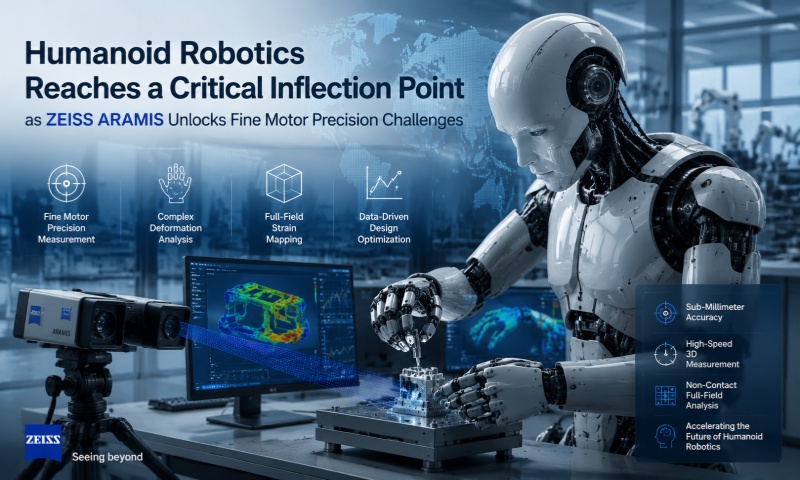
At the center of this breakthrough is ZEISS ARAMIS, an advanced optical 3D deformation and motion analysis system developed by ZEISS, which is now being widely adopted in robotics R&D labs to decode and optimize complex human-like movements.
Industry experts describe this moment as a “critical turning point” for humanoid robots transitioning from controlled demonstrations to scalable real-world deployment.
While humanoid robots have achieved significant progress in locomotion, balance, and basic manipulation tasks, fine motor skills—such as precise gripping, tool handling, assembly, and adaptive force control—remain a major technical bottleneck.
Key challenges include:
Micro-scale instability in joint actuation
Inconsistent force feedback during object manipulation
Delayed sensor fusion in multi-joint coordination
Limited real-world training data for dexterous tasks
These issues prevent robots from performing complex industrial or service tasks reliably in unstructured environments.
The ZEISS ARAMIS system has emerged as a critical enabling technology for solving these problems.
ZEISS ARAMIS is a high-precision, non-contact optical measurement system that captures full-field 3D motion and deformation with extreme accuracy. It is widely used in automotive testing, aerospace engineering, biomechanics, and now increasingly in robotics development.
By applying ARAMIS to humanoid robot testing, engineers can now:
Track sub-millimeter joint displacement in real time
Measure deformation patterns during grasping and manipulation
Analyze synchronization between multi-joint systems
Map force distribution across robotic fingertips and actuators
This level of data granularity enables robotics teams to move beyond simulation-based tuning into real-world biomechanical validation.
Historically, humanoid robot development has relied heavily on simulation environments. While useful, these models often fail to capture real-world complexities such as friction variability, material deformation, and unpredictable object dynamics.
ZEISS ARAMIS changes this paradigm by introducing a feedback loop between physical motion and digital modeling.
Engineers can now:
Compare simulated motion against real-world execution
Identify divergence points in joint behavior
Retrain control algorithms with high-fidelity physical data
Optimize grasping strategies for irregular objects
This shift is accelerating the development of what researchers call “physical intelligence”—robots that learn not just from code, but from measurable interaction with the physical world.
The integration of ARAMIS into humanoid robotics research is already influencing multiple sectors:
Humanoid robots are being tested for precision assembly tasks such as electronics manufacturing, where micro-level accuracy is essential.
Robots capable of tool handling and adaptive torque control are being evaluated for flexible production lines.
Fine motor measurement is critical for robotic systems designed for elderly care, surgery assistance, and rehabilitation support.
Dexterous manipulation allows robots to handle irregular packages and fragile goods more effectively.
One of the most significant contributions of ZEISS ARAMIS is its ability to visualize micro-motion behavior in robotic joints and end-effectors.
This includes:
Slip detection during object grasping
Micro-vibration patterns under load
Elastic deformation in synthetic tendon systems
Dynamic compensation delays in actuator networks
By capturing these phenomena in high resolution, engineers can redesign both hardware and control algorithms to improve stability and precision.
According to robotics analysts, the combination of humanoid hardware maturity and advanced metrology tools like ARAMIS signals a transition from experimental robotics to scalable deployment.
A senior robotics systems engineer noted:
“We’ve reached a point where the hardware is no longer the limiting factor. The real challenge is understanding motion at the millimeter and sub-millimeter level—and ARAMIS finally gives us that visibility.”
This visibility is critical for moving humanoid robots from controlled lab environments into dynamic real-world settings.
The integration of high-precision motion capture also enhances AI model training pipelines.
With ARAMIS-generated datasets, developers can:
Train reinforcement learning models on real-world physical feedback
Improve sim-to-real transfer accuracy
Reduce reliance on synthetic motion data
Enhance adaptability in unpredictable environments
This is particularly important for next-generation humanoid platforms that rely on embodied AI systems.
As demand for humanoid robots grows, major robotics companies and research institutions are increasingly competing to integrate advanced measurement systems into their development cycles.
The result is a rapid convergence of:
AI control systems
High-fidelity mechanical engineering
Precision optical metrology
ZEISS ARAMIS has effectively become a foundational tool in this ecosystem, bridging the gap between theoretical robotics and industrial deployment.
The humanoid robotics industry is entering a pivotal stage where mechanical capability alone is no longer sufficient. The ability to measure, understand, and optimize fine motor behavior is now the defining factor in real-world success.
With ZEISS ARAMIS enabling unprecedented visibility into micro-motion dynamics, the industry is moving closer to achieving robots that can truly operate in human environments with human-like dexterity.
As one industry observer summarized:
“We are no longer asking whether humanoid robots can walk or grasp. We are now asking whether we can measure every fraction of that motion—and finally, we can.”
The era of precision-driven humanoid robotics has officially begun.