
Consultation Hotline
+1 (302) 618-8777
+1 (302) 618-8777
Current location:Home > Blogs > Industry News
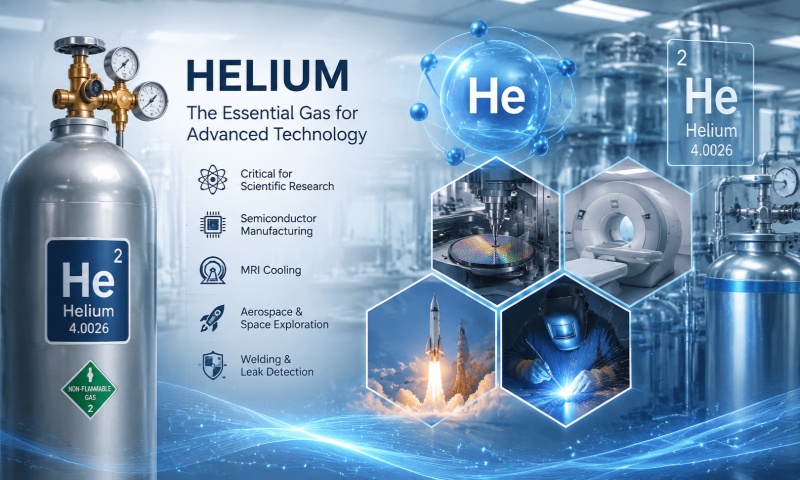
— A Global Industry Alert on the Fragile Foundations of Advanced Manufacturing
July 2026 | International Technology & Energy Desk
A sudden 131% surge in global helium prices has sent shockwaves through the semiconductor industry, exposing a fragile and often overlooked dependency in advanced chip manufacturing. Triggered by escalating geopolitical tensions in the Middle East—one of the world’s most critical helium supply regions—the crisis is now being described by analysts as a “silent choke point” threatening global semiconductor production capacity.
While public attention has largely focused on oil routes and LNG markets, helium—a colorless, odorless, and non-renewable gas essential for semiconductor fabrication—has emerged as a strategic weak point in the global tech supply chain.
Helium plays a crucial role in semiconductor production, particularly in processes requiring ultra-low temperatures, controlled environments, and high-precision lithography systems. It is widely used in:
Cooling superconducting magnets in semiconductor equipment
Purging and pressurizing wafer fabrication chambers
Leak detection in vacuum systems
Cryogenic applications in advanced research and EUV lithography support systems
Unlike many industrial gases, helium cannot be synthetically produced at scale. It is primarily extracted as a byproduct of natural gas processing, with major supply concentrations in the United States, Qatar, Algeria, and Russia-linked infrastructure routes.
This structural limitation makes the global helium supply highly vulnerable to geopolitical disruptions.
According to industry sources, the current price surge was triggered after escalating tensions in the Middle East disrupted logistics and export stability from key helium-producing facilities in the region.
Shipping routes through critical energy corridors have become increasingly unstable, causing delays in liquefied helium shipments destined for Asia, Europe, and North America.
Even short-term interruptions have had a disproportionate effect on pricing due to:
Extremely limited global storage capacity
High purity requirements for semiconductor-grade helium
Just-in-time delivery dependency in fabrication plants
Within weeks, spot market helium prices reportedly increased by more than 131%, marking one of the sharpest spikes in the last decade.
The semiconductor industry, already under pressure from advanced node complexity and rising capital expenditure, now faces a less visible but equally critical challenge: material fragility.
While companies such as TSMC, Intel, and Samsung have diversified supply chains for silicon wafers, photomasks, and specialty chemicals, helium has remained under-hedged due to its historically stable pricing and niche perception.
Industry analysts warn that this assumption is now outdated.
A senior supply chain strategist commented:
“Helium was never considered a strategic risk—until it became one. This is not just a commodity shock. It’s a manufacturing continuity issue.”
The impact is already being felt across semiconductor fabs, where helium shortages are forcing:
Reduced wafer throughput in some facilities
Reprioritization of high-margin chip production
Increased equipment maintenance intervals
Emergency rationing of ultra-high-purity gas usage
Semiconductor fabrication plants operate under extreme precision constraints. Even minor disruptions in gas supply chains can cascade into significant production inefficiencies.
Helium shortages are particularly disruptive because they affect both front-end wafer processing and back-end equipment calibration systems.
Key risks include:
Advanced lithography systems require stable cryogenic environments. Reduced helium availability forces temporary shutdowns or performance throttling.
Inconsistent gas purity and pressure stability can lead to micro-defects in wafers, reducing yield rates in high-value chips.
Preventive maintenance cycles depend on helium-based leak detection systems, slowing down equipment servicing schedules.
Semiconductor fabs are now facing rising operational expenditure (OPEX), with helium procurement costs becoming a growing line item.
The helium crisis is not isolated to semiconductors. It is also impacting:
MRI and medical imaging systems
Aerospace testing and propulsion systems
Fiber optic manufacturing
Quantum computing research laboratories
High-energy physics facilities
However, the semiconductor industry remains the most exposed due to its scale, precision requirements, and dependency on continuous production cycles.
In response to the crisis, semiconductor manufacturers and equipment suppliers are accelerating several mitigation strategies:
Companies are actively seeking alternative helium suppliers outside traditional geopolitical hotspots, including expanded contracts in North America and Australia.
Advanced fabs are investing in helium recovery systems to capture and reuse gas from manufacturing processes.
Although limited, research is underway to replace helium in certain cooling and purge applications with hydrogen-based or nitrogen-based alternatives.
Some manufacturers are increasing on-site helium reserves, though storage limitations make large-scale buffering difficult.
Market analysts believe the current price spike may not be temporary. Instead, it could mark the beginning of a long-term structural repricing of helium as a strategic industrial resource.
Several key factors support this outlook:
Declining global helium reserves from traditional extraction fields
Increased demand from advanced medical and quantum technologies
Geopolitical concentration of remaining supply routes
Lack of scalable synthetic alternatives
If sustained, the helium shortage could reshape semiconductor cost structures and influence global chip pricing in the coming years.
While semiconductors are often discussed in terms of lithography nodes, AI chips, and geopolitical competition, the helium crisis highlights a deeper truth: modern technology depends on a fragile ecosystem of rare and often invisible materials.
Helium—once considered a low-profile industrial gas—has now emerged as a strategic bottleneck in the global technology supply chain.
As one industry executive summarized:
“We built the future on atoms we barely think about. Helium just reminded us how fragile that future really is.”
The 131% surge in helium prices marks more than a commodity shock—it signals a systemic vulnerability in global semiconductor manufacturing. As geopolitical instability intersects with structural supply constraints, industries dependent on ultra-high-purity gases are being forced to rethink long-held assumptions about stability and resilience.
In the race toward advanced computing, AI, and next-generation electronics, helium may become one of the most critical—and contested—resources of the decade.