Consultation Hotline
+1 (302) 618-8777
+1 (302) 618-8777
Current location:Home > Blogs > Industry News
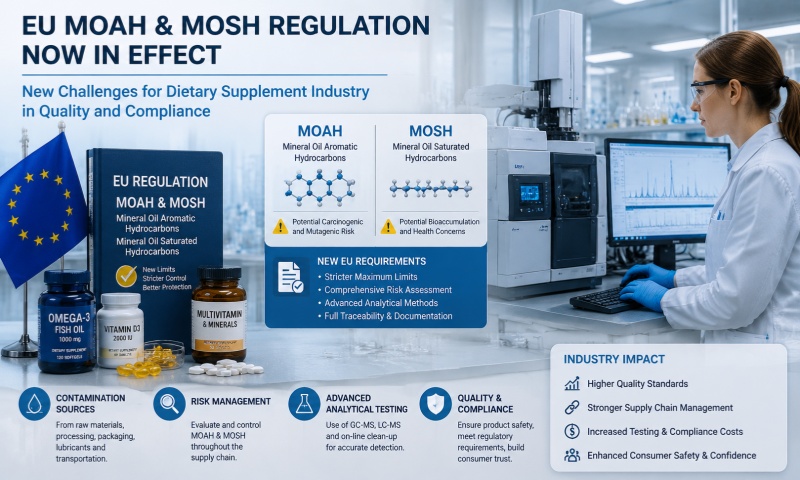
The European Union has officially strengthened its regulatory framework regarding Mineral Oil Aromatic Hydrocarbons (MOAH) and Mineral Oil Saturated Hydrocarbons (MOSH), marking a significant step forward in food safety governance. The updated requirements introduce stricter limits, enhanced monitoring obligations, and more advanced analytical expectations for food and dietary supplement manufacturers. This regulatory shift is expected to have a profound impact on global supply chains, quality control systems, and compliance strategies across the dietary supplement industry.
MOAH and MOSH are mineral oil-derived contaminants that can enter food products through multiple pathways, including environmental contamination, processing equipment lubricants, packaging materials, and transportation processes. MOAH compounds, in particular, have raised concern due to their potential genotoxic and carcinogenic properties, while MOSH may accumulate in human tissues over time, potentially affecting the liver and lymphatic system. As scientific understanding of their health risks has evolved, regulatory authorities in the EU have progressively tightened permissible limits and expanded monitoring requirements.
The newly introduced EU regulations place a stronger emphasis on risk-based control strategies and end-to-end contamination prevention. Dietary supplement products, especially those containing botanical extracts, oils, lipid-based formulations, and animal-derived ingredients, are now under increased scrutiny. Manufacturers are required to conduct more comprehensive assessments of raw materials, production processes, and packaging systems to ensure compliance with updated MOAH and MOSH thresholds.
A key element of the regulatory update is the reinforcement of analytical requirements. Laboratories are expected to adopt highly sensitive and selective methods capable of detecting trace-level mineral oil hydrocarbons in complex matrices. Advanced techniques such as gas chromatography–mass spectrometry (GC-MS), liquid chromatography–mass spectrometry (LC-MS), and comprehensive two-dimensional chromatography are increasingly recommended to ensure accurate separation and quantification of MOAH and MOSH fractions.
For the dietary supplement industry, the implications are substantial. Companies must reassess their entire supply chain to identify potential contamination sources, including raw material origins, manufacturing equipment, lubricants, and packaging materials. Preventive measures such as the use of food-grade lubricants, improved process isolation, and stricter supplier qualification systems are becoming essential components of compliance strategies.
In addition, quality control laboratories face increasing pressure to upgrade their analytical capabilities. Traditional testing approaches may not be sufficient to meet the lower detection limits and higher specificity required under the new regulations. As a result, many organizations are investing in high-resolution mass spectrometry, automated sample preparation systems, and advanced chromatographic separation technologies to improve analytical performance and throughput.
Industry experts view the new EU regulations as part of a broader global trend toward stricter food safety oversight and more transparent supply chain management. Regulatory agencies are shifting from end-product testing toward comprehensive contamination prevention strategies that address risks at every stage of production. This transition reflects growing consumer awareness and demand for higher safety standards in food and dietary supplement products.
Third-party testing laboratories and contract research organizations are expected to play an increasingly important role in supporting industry compliance. As analytical complexity increases, demand for specialized testing services with advanced instrumentation and multi-residue analysis capabilities is likely to grow significantly.
It is also worth noting that regulatory attention to MOAH and MOSH is not limited to the European Union. Several European countries, including Germany, France, and the Netherlands, have already issued national guidance documents, while international organizations continue to evaluate harmonized approaches to mineral oil hydrocarbon control. This indicates a global convergence toward stricter regulation of these contaminants in food systems.
In conclusion, the EU’s updated MOAH and MOSH regulations represent a major advancement in food safety governance and introduce significant new challenges for the dietary supplement industry. While compliance will require increased investment in analytical infrastructure, supply chain management, and quality assurance systems, the long-term impact is expected to enhance product safety, improve consumer trust, and drive technological innovation across the industry.
As regulatory expectations continue to evolve, companies that proactively strengthen their compliance frameworks and adopt advanced analytical technologies will be better positioned to maintain competitiveness in the global market.