
Consultation Hotline
+1 (302) 618-8777
+1 (302) 618-8777
Current location:Home > Blogs > Industry News
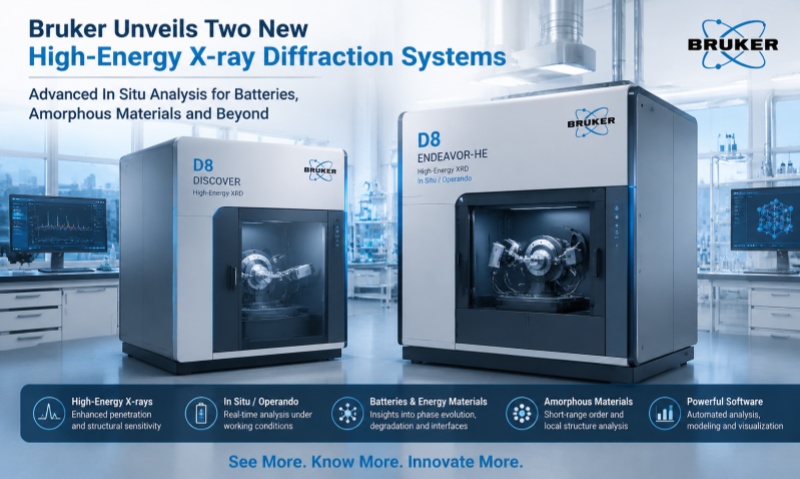
Bruker today announced the launch of two new high-energy X-ray diffraction (XRD) systems designed to significantly expand capabilities in in situ and operando materials characterization. The new platforms are engineered to meet the growing demands of advanced research in energy storage, amorphous materials, and complex multiphase systems, where real-time structural insights are critical to scientific and industrial innovation.
As global demand for high-performance batteries and next-generation functional materials continues to accelerate, researchers are increasingly required to observe structural evolution under real working conditions. Traditional diffraction techniques, while highly effective for static analysis, often face limitations in temporal resolution, penetration depth, and environmental adaptability. Bruker’s newly introduced high-energy XRD systems address these challenges by combining high-brilliance X-ray sources, advanced detection technologies, and optimized experimental geometries for enhanced in situ performance.
The two newly launched systems are designed with complementary strengths. The first platform focuses on high-throughput structural analysis, enabling rapid data acquisition and automated workflows for materials screening and phase identification. The second system is optimized for advanced in situ and operando experiments, supporting dynamic studies under variable temperature, electrochemical cycling, atmospheric control, and mechanical stress conditions.
In battery research applications, the new systems enable detailed observation of structural transformations during charge and discharge cycles. This includes phase transitions, lattice expansion and contraction, electrode–electrolyte interface evolution, and degradation mechanisms. By capturing these processes in real time, researchers can gain deeper insights into performance limitations and failure pathways, ultimately supporting the development of higher-energy-density and longer-lifetime battery technologies.
For amorphous and nanostructured materials, high-energy X-rays provide enhanced penetration and improved sensitivity to short-range ordering. The new Bruker systems, combined with high-efficiency detectors, allow for more accurate analysis of weak scattering signals, enabling researchers to study local atomic arrangements and structural dynamics with unprecedented clarity.
A key highlight of the new platforms is their expanded in situ experimental compatibility. The systems can be integrated with a wide range of sample environments, including heating and cooling stages, electrochemical cells, gas flow reactors, and mechanical loading devices. This flexibility enables true operando measurements that closely replicate real-world operating conditions, providing more meaningful and application-relevant structural data.
In addition to hardware advancements, Bruker has introduced an upgraded software ecosystem designed to streamline experimental workflows and data interpretation. The integrated platform supports automated peak detection, phase identification, Rietveld refinement, and time-resolved data analysis. Machine-assisted processing tools further enhance productivity by reducing manual intervention and improving data consistency across large datasets.
According to Bruker, the launch of these two systems represents not only a technological upgrade but also a strategic step toward enabling the next generation of materials science research. As scientific questions become increasingly complex, particularly in energy storage and functional materials, the need for real-time, high-resolution structural information continues to grow.
Industry experts note that the introduction of these high-energy XRD platforms comes at a critical time for global research communities. With rapid advancements in renewable energy, electric vehicles, and advanced manufacturing, demand for sophisticated analytical tools is rising sharply. Bruker’s latest systems are expected to play a key role in accelerating discoveries across academia, national laboratories, and industrial R&D centers.
By enabling deeper understanding of structural dynamics under real operating conditions, these systems are poised to bridge the gap between fundamental research and practical application. This alignment is expected to significantly accelerate innovation cycles in energy materials, catalysis, semiconductors, and beyond.
Overall, Bruker’s new high-energy X-ray diffraction systems mark a significant milestone in analytical instrumentation. With enhanced in situ capabilities, improved detection sensitivity, and integrated data analysis tools, they provide researchers with a powerful platform for exploring complex material behaviors in unprecedented detail.