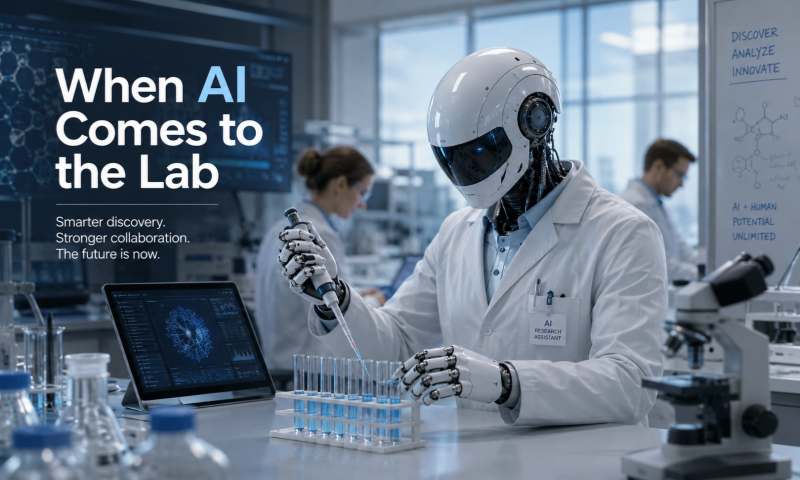
The rapid development of artificial intelligence is reshaping modern laboratory operations, bringing profound changes from traditional instrument functions to overall experimental workflows. For decades, laboratory work relied heavily on manual operation, empirical judgment and repetitive human labor. Instrument detection, data recording, result analysis and fault diagnosis were time-consuming and prone to human error. With the integration of AI technology, laboratories are stepping into an intelligent, efficient and precise new era, realizing comprehensive upgrades of instrument performance, operational logic and workflow management.
The most intuitive change lies in the intelligent iteration of traditional analytical instruments. Conventional laboratory devices such as chromatographs, spectrometers and reaction kettles can only complete single execution tasks according to manual settings, lacking autonomous judgment and adaptive adjustment capabilities. After embedding AI algorithms and intelligent sensing modules, these instruments achieve real-time data monitoring, automatic parameter optimization and intelligent fault early warning. For example, AI-powered analytical instruments can automatically identify abnormal peaks, baseline fluctuations and unstable pressure during detection, independently adjust flow rate, temperature and other parameters, and correct system deviations in real time. This intelligent transformation fundamentally makes up for the shortcomings of fixed instrument parameters and passive operation in the past.
Beyond equipment upgrades, AI has brought more disruptive innovations to laboratory overall workflows. Traditional experimental workflows follow a rigid linear mode: manual preparation, instrument operation, artificial recording, data sorting and manual result analysis. The whole process involves multiple human interventions, leading to low efficiency, inconsistent operation standards and unavoidable human errors. AI reconstructs the entire laboratory workflow through automatic scheduling, intelligent data processing and standardized process control. It can automatically arrange experimental sequences, optimize detection schemes according to sample characteristics, and realize one-stop completion of sample analysis, data fitting, result comparison and report generation.
In addition, AI optimizes laboratory quality control and risk management throughout the process. Traditional laboratories rely on staff experience to judge experimental validity and equipment operating status, with strong subjectivity and lagging fault response. The AI system can learn massive experimental data and equipment operation rules, accurately identify abnormal experimental data, predict instrument aging trends and potential faults in advance, and issue early warnings before equipment failure and data invalidation. This predictive maintenance and real-time quality control mode greatly reduces experimental failure rate, equipment downtime and laboratory operating costs.
Meanwhile, AI promotes standardized and unified laboratory operation. Different operators have different operating habits and empirical differences, resulting in poor repeatability of experimental results. AI-driven workflow systems solidify standard operating procedures into intelligent programs, unify instrument operation parameters, experimental steps and data judging criteria, eliminate human-induced operational deviations, and significantly improve the repeatability, accuracy and traceability of experimental data.
In conclusion, the application of AI in laboratories is not a simple technical superposition on instruments, but a comprehensive revolution covering equipment functions, experimental processes and quality management. It transforms laboratories from labor-intensive and experience-dependent traditional modes to intelligent, standardized and efficient modern operation modes. In the future, with the continuous deep integration of AI and laboratory technology, intelligent laboratories will further break the limitations of manual operation, greatly improve scientific research and detection efficiency, and provide stronger support for the development of modern analytical testing and scientific research industries.