
Consultation Hotline
+1 (302) 618-8777
+1 (302) 618-8777
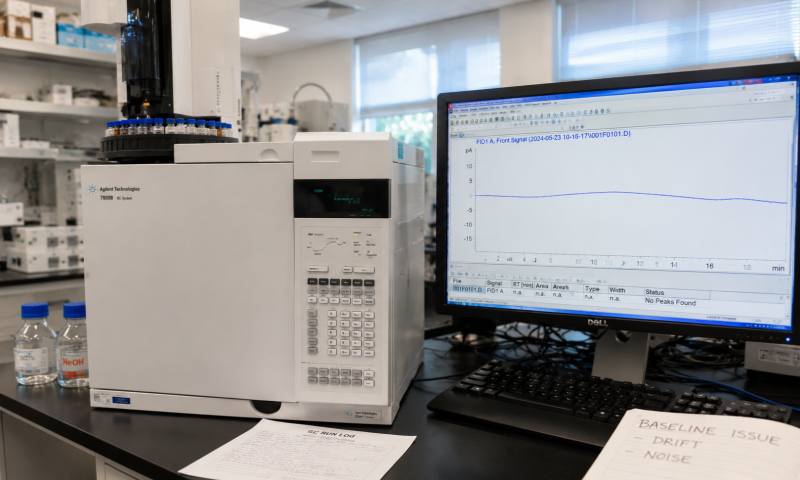
Gas chromatography (GC) is widely used in environmental testing, pharmaceutical analysis, petrochemical research, food safety, and chemical quality control due to its excellent separation capability and high sensitivity. In routine GC operation, retention time stability is one of the most important indicators for reliable qualitative and quantitative analysis. However, many laboratories experience retention time drift, where peaks appear earlier or later than expected. One of the most common causes is gas chromatography column contamination, which affects the interaction between analytes and the stationary phase, resulting in unstable chromatographic performance.
Understanding the causes of retention time drift and applying systematic troubleshooting methods can significantly improve GC reliability and reduce unnecessary downtime.
Retention time is the time required for a compound to travel through the GC column and reach the detector. Under stable operating conditions, the retention time of a compound should remain consistent within a small range.
When retention time changes gradually or suddenly, it may indicate problems with:
Column condition;
Carrier gas flow;
Temperature control;
Injection system;
Sample matrix effects;
Detector or electronic control systems.
Retention time drift can appear as:
All peaks shifting in the same direction;
Only specific compounds showing movement;
Increasing peak tailing;
Poor separation between adjacent peaks;
Reduced response and unstable quantitation.
The GC column is the core separation component. During continuous operation, contaminants from samples and the injection system can accumulate at the column inlet or interact with the stationary phase.
Complex samples often contain non-volatile or high-boiling compounds that cannot completely elute from the column.
Common contamination sources include:
Biological extracts;
Food samples containing fats and oils;
Soil and environmental samples;
Petroleum-based materials;
Dirty solvent residues.
These contaminants accumulate mainly near the column inlet, changing the active surface properties of the stationary phase.
The result is:
Longer or shorter retention times;
Peak tailing;
Loss of resolution;
Increased baseline noise.
The injection system directly affects the condition of the GC column.
Common problems include:
Dirty inlet liner;
Degraded septum particles;
Contaminated glass wool;
Incorrect split ratio;
Excessive sample loading.
When contaminants enter the column through the inlet, they can gradually damage the stationary phase and cause retention instability.
Recommended maintenance:
Replace liners regularly;
Change septa according to injection frequency;
Clean the inlet regularly;
Verify injection temperature settings.
Carrier gas flow stability directly determines compound migration speed through the column.
Changes in carrier gas conditions can cause retention time shifts.
Possible causes include:
Gas leaks;
Incorrect pressure settings;
Faulty electronic pressure control (EPC);
Blocked gas filters;
Unstable gas supply.
Typical symptom:
If all peaks shift by a similar percentage, carrier gas flow should be checked first.
Troubleshooting steps:
Verify carrier gas pressure;
Check for leaks around fittings;
Confirm actual column flow using a flow meter;
Inspect EPC performance.
A small flow change can significantly affect retention times, especially for capillary columns.
GC columns have a limited service life. Continuous exposure to high temperatures, oxygen, and reactive compounds can degrade the stationary phase.
Signs of column aging include:
Gradual retention time changes;
Increased column bleed;
Reduced sensitivity;
Higher background noise;
Poor peak symmetry.
High-temperature operation above the recommended limit accelerates stationary phase degradation.
Solutions:
Perform regular column conditioning;
Avoid oxygen entering the column;
Operate within recommended temperature limits;
Replace severely damaged columns.
GC separation depends heavily on accurate oven temperature control.
Temperature-related retention time drift may be caused by:
Incorrect oven temperature program;
Temperature sensor failure;
Poor oven calibration;
Unstable heating or cooling performance.
If retention times change mainly during temperature-programmed analysis, check:
Initial temperature accuracy;
Ramp rate;
Final temperature stability;
Oven calibration.
A small temperature difference can significantly affect volatile compound retention.
When retention time drift occurs, a step-by-step approach is recommended.
Determine whether:
All peaks shift together;
Only late-eluting peaks shift;
Only certain compounds are affected.
This helps identify whether the problem comes from flow, temperature, or column contamination.
Inspect:
Injector liner;
Septum;
Syringe;
Split vent pathway.
Replace contaminated consumables if necessary.
Perform:
Column bake-out;
Solvent rinsing (if applicable);
Removal of contaminated column section.
For inlet contamination, cutting 0.5–1 meter from the column front can sometimes restore performance.
Check:
Carrier gas pressure;
Column flow rate;
Oven temperature accuracy;
Leak status.
To minimize GC retention time drift, laboratories should establish preventive maintenance procedures:
| Maintenance Item | Recommended Action |
|---|---|
| Sample preparation | Filter and clean samples before injection |
| Injection liner | Replace regularly |
| Septum | Replace before excessive bleeding occurs |
| Column inlet | Trim contaminated sections when needed |
| Carrier gas | Use high-purity gas with proper filters |
| System inspection | Perform routine leak checks |
Regular maintenance prevents contamination buildup and extends column lifetime.
Retention time drift in gas chromatography is a common but manageable problem. Column contamination is one of the primary causes, especially when analyzing complex samples with high matrix content. However, carrier gas instability, injector contamination, temperature fluctuations, and column aging can also contribute to retention changes.
A systematic troubleshooting strategy that begins with identifying drift patterns, checking the injection system, evaluating column condition, and verifying gas and temperature control can quickly restore GC performance. Proper preventive maintenance and contamination control are essential for achieving stable retention times, accurate identification, and reliable analytical results.