
Consultation Hotline
+1 (302) 618-8777
+1 (302) 618-8777
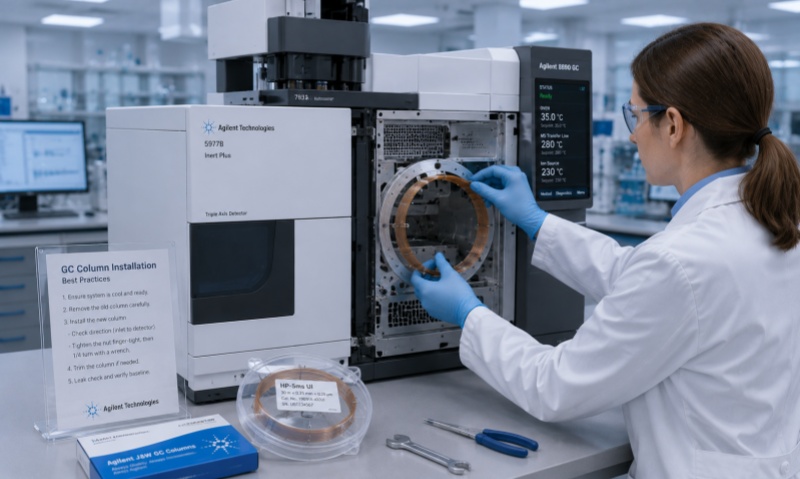
In High Performance Liquid Chromatography (HPLC), the column (COL) is the most critical and sensitive component of the separation system. Even under normal operating conditions, the stationary phase gradually degrades due to chemical stress, physical fouling, and mechanical pressure. Knowing when to replace the column is essential to maintain data reliability, reproducibility, and system performance. This article provides a systematic technical guide for evaluating column lifetime and identifying replacement indicators.
One of the earliest and most reliable indicators of column aging is a gradual increase in backpressure.
Baseline pressure slowly rises over multiple runs
Pressure remains high even after replacing inline filter or guard column
Backpressure does not return to normal after solvent flushing
Frit blockage at column inlet
Particle accumulation within packed bed
Stationary phase collapse or channeling
If pressure increases by more than 50–100% compared to the initial baseline under identical conditions, the column is approaching end-of-life.
Peak shape is a direct reflection of column efficiency.
Increased peak width (loss of efficiency)
Peak tailing (asymmetric peaks, tailing factor > 2)
Peak fronting in overloaded conditions
Split peaks under previously stable methods
Active site exposure due to bonded phase degradation
Contaminant adsorption on stationary phase
Poor wetting or void formation
When peak symmetry cannot be restored even after column washing/regeneration, replacement is recommended.
Column efficiency is often expressed as theoretical plate number (N).
Significant drop in N compared to initial column performance
Reduced resolution (Rs) between critical peaks
Co-elution of previously separated compounds
Stationary phase degradation
Channeling inside the packed bed
Mechanical compression from long-term high pressure
A drop of more than 20–30% in theoretical plate count is a strong indicator of column aging.
Retention time stability is essential for quantitative analysis.
Increasing retention time variability (RT drift)
Poor run-to-run repeatability
Inconsistent calibration curves
Surface chemistry changes in stationary phase
Partial contamination blocking interaction sites
Temperature or mobile phase sensitivity amplified by aging column
If RT RSD exceeds method acceptance limits (commonly >1–2%), column condition should be questioned.
Some columns suffer from irreversible fouling that cannot be removed by flushing.
Persistent ghost peaks
Baseline noise increase
Inability to restore performance after strong solvent wash (e.g., high organic, acid/base rinse)
Strongly retained matrix components
Protein or polymer adsorption
Inorganic salt precipitation
Once contamination becomes irreversible, replacement is the only reliable solution.
Selectivity changes indicate chemical degradation of the stationary phase.
Peak order changes
Loss of resolution between critical pairs
Unexpected co-elution or separation reversal
Bonded phase hydrolysis
End-capping degradation
Surface chemistry alteration due to extreme pH exposure
This is often irreversible and strongly indicates end-of-life status.
Physical damage inside the column bed is a critical failure mode.
Sudden peak splitting
Distorted peak shape across all analytes
Pressure instability or sudden drop
Mechanical shock or pressure surges
Poor packing integrity
Solvent incompatibility
Void formation cannot be repaired in most analytical columns.
Increasing baseline instability is another aging indicator.
Rising baseline noise level
Appearance of ghost peaks in blank runs
UV absorbance instability
Leaching of stationary phase components
Contaminant release from fouled surface
Detector contamination secondary to column bleed
A practical criterion used in routine labs.
Perform column wash using strong solvent (acidic, basic, high organic)
Equilibrate and rerun standard test mixture
High pressure
Poor peak shape
Low efficiency
???? The column should be replaced.
Manufacturers typically define column lifetime based on:
Number of injections
Operating pressure cycles
pH and solvent compatibility
Routine analytical columns: 500–2000 injections
High matrix samples: significantly shorter lifetime
Even without obvious symptoms, performance validation failure after routine QC test indicates replacement need.
In regulated environments (pharma, QC labs), compliance criteria determine replacement.
System suitability test (SST) failure
Resolution below specification
Retention time or area precision out of range
In such cases, even partially functional columns must be replaced to ensure compliance.
Determining when an HPLC column (COL) should be replaced requires evaluating multiple performance indicators, including backpressure, efficiency, peak shape, selectivity, and reproducibility. A combination of physical damage (void formation), chemical degradation (bonded phase loss), and irreversible contamination typically defines the end of column life.
A systematic approach—starting from pressure monitoring, followed by efficiency testing and selectivity evaluation—ensures reliable decision-making. Timely replacement of aging columns not only improves analytical accuracy but also protects the entire LC system from further contamination and damage.