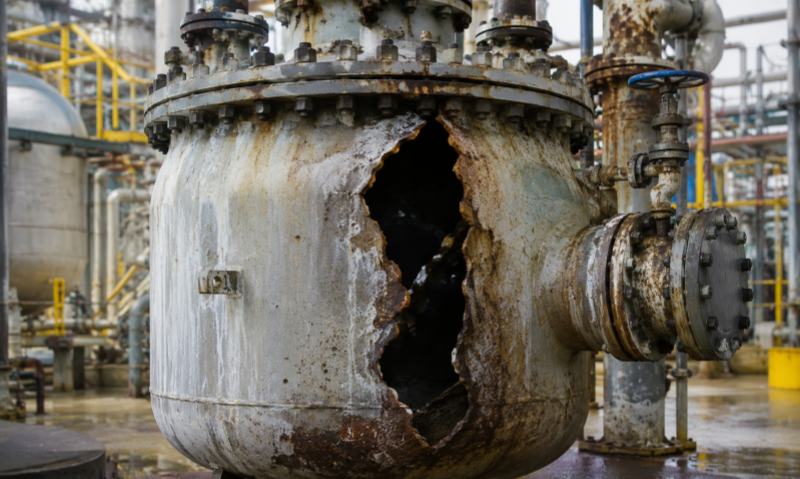
Chemical reaction kettles are core pressure-bearing equipment widely used in chemical, pharmaceutical, environmental protection and material processing industries. They operate under complex working conditions of high temperature, high pressure, strong acid and alkali corrosion, and alternating stress for a long time. Corrosion and fracture damage are the most common failure forms of reaction kettles, which gradually deteriorate from micro defects to macroscopic damage in stages. Clarifying the staged evolution rules of corrosion and fracture damage is of great significance for equipment safety inspection, fault early warning and regular maintenance, and can effectively prevent sudden equipment failure and production safety accidents.
The first stage is micro corrosion incubation and subtle material deterioration. In the initial service period, the inner wall of the reaction kettle is intact with no obvious damage on the surface. Under the long-term erosion of corrosive media such as acid, alkali and salt solution, tiny chemical reactions occur on the metal surface, forming invisible micro pits and passivation film defects. High temperature and stirring scouring will gradually destroy the protective oxide film, resulting in uniform micro corrosion on the metal matrix. At this stage, the equipment has no abnormal pressure drop or appearance change, and the mechanical performance attenuation is extremely slight, which is easy to be ignored in daily inspection.
The second stage is localized corrosion expansion and defect growth. With the continuous accumulation of corrosion medium erosion, micro pits gradually expand and deepen to form localized pitting corrosion, crevice corrosion and intergranular corrosion. The metal wall thickness decreases unevenly, and local material strength declines significantly. Under the action of alternating pressure and stirring vibration stress, tiny fatigue cracks begin to germinate at corrosion defects and stress concentration points. In this stage, slight wall thinning and local rust spots can be observed on the kettle body, and the equipment operation presents minor pressure fluctuation, which is the key period for early maintenance and defect repair.
The third stage is crack propagation and structural performance degradation. If the localized corrosion and micro cracks are not treated in time, the stress will continuously concentrate on the defect parts during repeated production operation. The tiny cracks expand rapidly along the grain boundary and corrosion area, forming macroscopic visible cracks. Corrosive media further penetrate into the metal interior through the cracks, accelerating internal corrosion and causing a vicious cycle of crack expansion and matrix corrosion. At this stage, the reaction kettle shows obvious wall thinning, surface peeling and abnormal vibration, and the pressure resistance and sealing performance of the equipment decrease significantly, which greatly affects production safety.
The fourth stage is final fracture failure and equipment scrapping. When the crack length and corrosion thinning degree exceed the safety threshold of equipment design, the residual strength of the kettle body cannot bear the working pressure and load. Under the impact of instantaneous temperature and pressure fluctuation, brittle fracture or leakage rupture occurs at the damaged position, resulting in medium leakage, equipment shutdown and even safety accidents. This stage is the final failure state of the reaction kettle, which is irreversible and can only be solved by replacement and overall maintenance.
In conclusion, the corrosion and fracture damage of reaction kettles is a progressive and periodic failure process from micro deterioration to macroscopic fracture. Most sudden equipment failures are caused by the neglect of early incubation and expansion defects. Regular wall thickness detection, corrosion inspection and crack flaw detection can effectively identify early damage. Timely repair and anti-corrosion treatment can delay equipment aging, eliminate potential safety hazards, and ensure the long-term safe and stable operation of reaction kettle equipment.