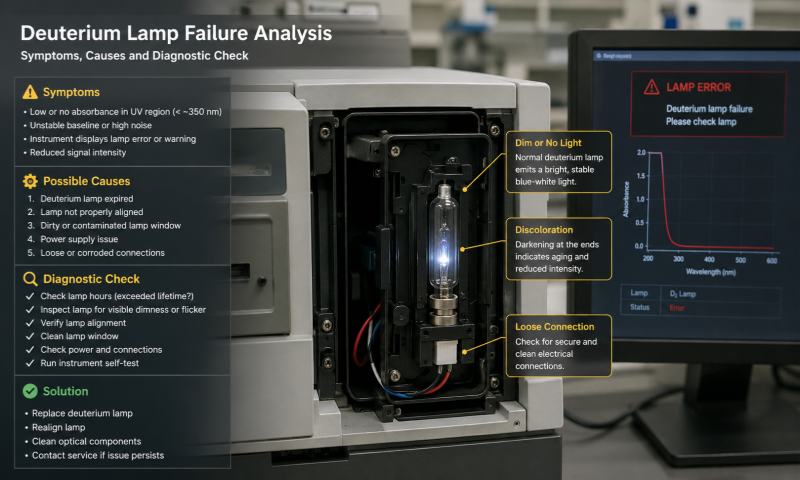
Deuterium lamps are core ultraviolet light source components widely equipped in high-performance liquid chromatography, ultraviolet-visible spectrophotometers and other analytical instruments. Providing stable and continuous ultraviolet spectral energy, they directly determine baseline stability, detection sensitivity and data accuracy of instrument analysis. As a consumable optical component, deuterium lamps will gradually age and fail after long-term operation. Understanding common failure types, root causes and service life end characteristics is essential for daily instrument maintenance, fault judgment and experimental quality control.
In actual laboratory operation, deuterium lamps mainly suffer from several typical faults. The first common problem is failure to ignite or difficulty in startup. This fault is mostly caused by excessive lamp aging, weakened ignition voltage, poor electrode contact or unstable power supply. When the lamp cannot be excited to generate ultraviolet light normally, the instrument will prompt light source abnormality, fail self-inspection or directly stop detection, resulting in interrupted experiments.
The second frequent failure is insufficient light energy and decreased sensitivity. With the extension of operating time, the internal cathode material of the deuterium lamp is continuously sputtered and consumed, leading to reduced luminous intensity and attenuated ultraviolet energy output. Although the lamp can light up normally, the baseline is noisy and fluctuating, the blank absorbance value rises abnormally, and the response of trace target compounds decreases significantly, which easily causes low detection accuracy and poor repeatability.
Third, flickering light and unstable baseline are typical aging manifestations. Severe lamp aging or internal gas leakage will cause unstable discharge inside the lamp tube. The light intensity fluctuates randomly during operation, presenting continuous baseline drift, irregular burrs and periodic jitter. Such faults cannot be eliminated by conventional calibration and cleaning, seriously affecting the qualitative and quantitative analysis of samples.
Judging the end of service life is the key point of deuterium lamp maintenance. The theoretical service life of conventional deuterium lamps is generally 2000 to 3000 working hours. When the operating hours approach the standard limit, the lamp performance declines sharply. In addition to time judgment, practical status identification is more accurate. If the light energy cannot reach the standard value after parameter adjustment, the baseline cannot be stabilized for a long time, or frequent ignition failures occur, it indicates that the deuterium lamp has reached its service life end and must be replaced in time.
Improper operation is an important factor accelerating lamp failure. Frequent startup and shutdown cause instantaneous current impact, which aggravates electrode loss. Long-term idle operation without sample detection leads to invalid light source consumption. Poor laboratory environment with humidity and dust will also corrode the lamp base and circuit, causing premature failure. Therefore, standardized operation, reducing unnecessary startup and shutdown, and maintaining a dry and clean environment can effectively extend the service life of deuterium lamps.
In conclusion, deuterium lamp faults are mainly reflected in ignition failure, insufficient luminous energy and unstable light source. Timely judging the service life end and replacing aging lamps can effectively avoid baseline abnormality and data deviation. Scientific maintenance and standardized operation reduce premature failure, ensure long-term stable operation of analytical instruments and guarantee the authenticity and accuracy of experimental detection data.