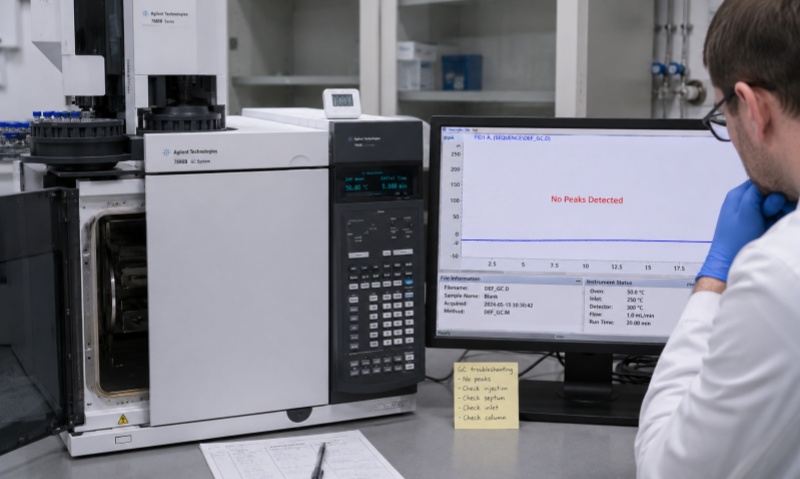
The phenomenon of no peak response during sample injection is one of the most common and troublesome faults in gas chromatography (GC) analysis. When the instrument operates normally with stable baseline but fails to generate any target chromatographic peak after sample injection, the entire experiment becomes invalid, seriously affecting laboratory testing efficiency and data accuracy. This fault is not caused by a single factor but involves multiple links including sample pretreatment, injection operation, gas path system, chromatographic column state, and detector performance. Comprehensive fault analysis and standardized troubleshooting are essential to restore instrument stability and ensure reliable qualitative and quantitative results.
Improper sample treatment and invalid sample status are primary causes of missing peaks. If the target compound has strong volatility, improper sample preservation or prolonged placement will lead to component volatilization and loss before injection. In addition, excessive sample dilution, ultra-low target concentration, or serious contamination of the sample solvent will reduce the response value below the instrument detection limit, resulting in invisible peaks. For thermally unstable compounds, degradation may occur during sample preparation, completely losing effective components. Therefore, fresh sample preparation, standardized preservation, and reasonable concentration configuration are the basic prerequisites for effective peak output.
Abnormal injection system is the most frequent operational cause of no peaks. Blocked or contaminated injection needles cannot suck or inject samples normally, resulting in zero sample volume entering the system. Loose injection port sealing and aging septum will cause serious air leakage, leading to sample loss during vaporization and injection process. Unreasonable split ratio setting is also a key factor; an excessively high split ratio will dilute trace target components completely, making them undetectable. Moreover, insufficient injection volume and irregular manual injection operation will cause unstable sample introduction and failure to form effective peaks.
Gas path disorder and column system failure will directly block component elution. Insufficient carrier gas pressure, unstable gas flow, or gas path blockage will interrupt the normal transmission of vaporized samples. Serious contamination or blockage at the front end of the chromatographic column will strongly adsorb target components, especially trace organic substances, preventing compounds from entering the detector. In addition, mismatched chromatographic column model, inappropriate polarity, or severely aged stationary phase will cause component retention failure and peak loss. Unreasonable oven temperature programs, such as excessively high initial temperature and rapid heating rate, may also lead to incomplete peak identification and missing target signals.
Detector abnormality is another critical factor leading to no peak response. For FID detectors, failure to ignite, unstable hydrogen-air flame ratio, or blocked nozzle will cause no signal response. Contaminated detector electrodes and incorrect sensitivity parameters will reduce detection performance and filter valid weak peaks. Meanwhile, unstable instrument power supply, poor grounding, and baseline saturation will interfere with signal acquisition, resulting in complete peak loss.
In conclusion, the no-peak fault in gas chromatography is mainly induced by sample invalidation, injection failure, gas path blockage, column adsorption, and detector abnormality. Laboratory staff should adopt a step-by-step troubleshooting method, checking sample status, injection system, gas circuit, chromatographic column, and detector in sequence. Standardizing daily operation and maintenance can effectively avoid peak missing faults, ensuring the accuracy, stability, and repeatability of GC detection results.