
Consultation Hotline
+1 (302) 618-8777
+1 (302) 618-8777
Current location:Home > Blogs > Industry News
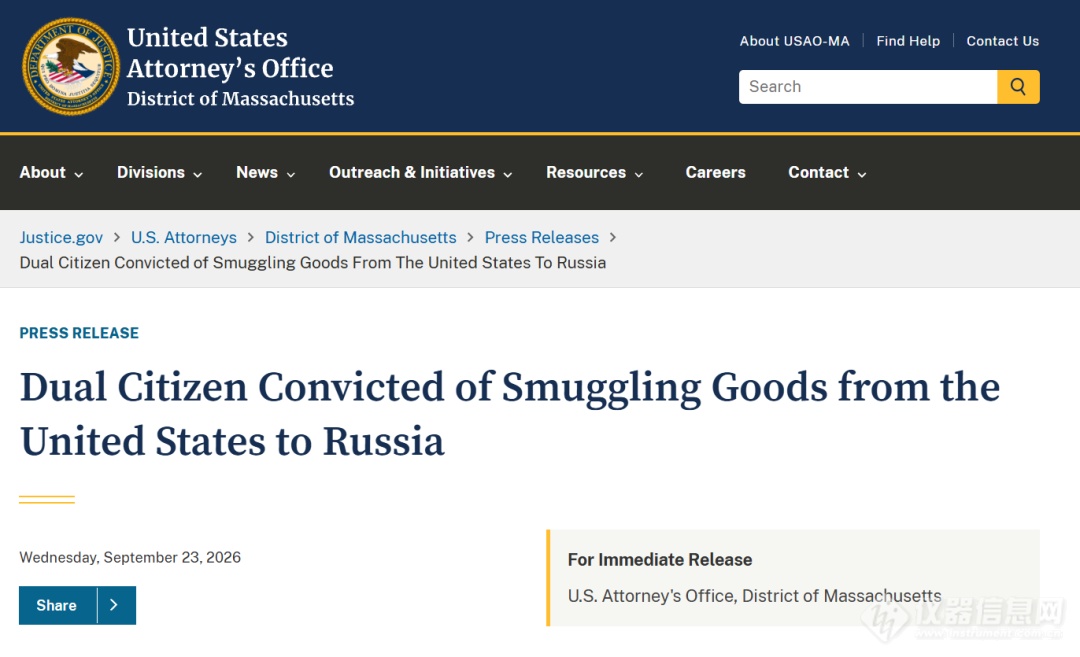
September 23, 2026 | Boston, Massachusetts, USA
A federal jury in Boston has convicted the president of a freight forwarding company for illegally exporting a high-end scientific mass spectrometer from the United States to Russia without obtaining the required export license. The case highlights the increasingly strict enforcement of U.S. export control regulations involving advanced scientific instruments and technologies.
According to an announcement released by the U.S. Attorney's Office for the District of Massachusetts on September 23, 2026, Kirill Gordei, 37, was found guilty of three federal offenses following a four-day jury trial. The charges include conspiracy to commit offenses against the United States, smuggling goods from the United States, and unlawfully exporting a spectrometer classified as a commerce control item.
The instrument involved in the case was a Thermo Scientific Orbitrap Exploris GC 240 Mass Spectrometer, a sophisticated analytical instrument widely associated with advanced scientific research and laboratory applications.
Court records and the Department of Justice announcement indicate that Gordei was the president of Apelsin Logistics, a freight forwarding company based in Hallandale Beach, Florida. The company also maintained an address in Russia and operated two websites registered and hosted there.
The investigation focused on a transaction arranged in August 2023.
According to prosecutors, Gordei facilitated the export of an Orbitrap Exploris GC 240 Mass Spectrometer from the United States to Russia without obtaining the necessary authorization from the U.S. Department of Commerce's Bureau of Industry and Security (BIS).
To conceal the actual destination of the equipment, Gordei allegedly provided falsified shipping documentation to an American freight forwarding company. The documents indicated that the mass spectrometer was being shipped to Uzbekistan.
However, the actual destination was Russia.
After the instrument arrived in Turkey, Gordei had reportedly arranged for it to be shipped directly to Moscow. This route was used to conceal the ultimate destination of the controlled scientific equipment and circumvent applicable U.S. export licensing requirements.
Following a four-day trial, the federal jury found Gordei guilty on all three counts.
The charges were:
Conspiracy to Commit Offenses Against the United States: Involving an agreement to circumvent applicable federal export control requirements.
Smuggling Goods from the United States: Relating to the unlawful movement of controlled goods outside the country.
Unlawful Export of a Commerce Control Item: Exporting a controlled scientific instrument without the required government authorization.
Gordei is a dual citizen of Belarus and the United States and resides in Hallandale, Florida. He was originally arrested and charged in June 2024.
U.S. District Court Judge Myong J. Joun has scheduled his sentencing for January 12, 2027.
The conviction demonstrates that U.S. authorities are continuing to investigate and prosecute individuals and businesses suspected of using international logistics networks to circumvent export restrictions.
The Orbitrap Exploris GC 240 is an advanced gas chromatography-mass spectrometry (GC-MS) system designed for demanding analytical applications.
It combines gas chromatographic separation with high-resolution Orbitrap mass spectrometry, enabling researchers to identify and characterize complex chemical compounds with high analytical performance.
Its applications include:
Pharmaceutical research and drug development.
Environmental contaminant analysis.
Food safety and quality testing.
Chemical compound identification.
Metabolomics and advanced life science research.
Industrial research and analytical testing.
Because of its advanced technological capabilities, the instrument was subject to U.S. export control requirements applicable to certain exports to Russia.
Following Russia's invasion of Ukraine in February 2022, the United States expanded restrictions on exports, reexports, and transfers of sensitive technologies to Russia.
On April 8, 2022, additional licensing requirements were implemented for items covered by the relevant Commerce Control List provisions.
According to the U.S. Department of Justice, the Orbitrap Exploris GC 240 involved in this case required a BIS export license before it could legally be exported to Russia.
The U.S. Attorney's Office emphasized that export controls play an important role in protecting national and international security.
U.S. Attorney Leah B. Foley stated that Gordei had gone to considerable lengths to evade export controls by falsifying the destination of controlled technology and routing the instrument through Turkey before sending it to Russia.
The U.S. Department of Commerce also emphasized its commitment to investigating and prosecuting violations of export control regulations.
The case involved cooperation among federal law enforcement agencies, including the Department of Commerce's Bureau of Industry and Security, U.S. Customs and Border Protection, the U.S. Marshals Service, and the Transportation Security Administration.
This case has important implications for manufacturers, distributors, used laboratory instrument dealers, and international freight forwarding companies.
The global scientific instrument market involves complex supply chains, cross-border transactions, equipment refurbishment, and international resale. High-value analytical instruments frequently move between manufacturers, distributors, research institutions, and independent laboratory equipment suppliers.
However, the resale or transportation of scientific instruments does not automatically exempt a transaction from export control requirements.
Companies involved in international instrument trading should carefully verify:
Whether the equipment is subject to export control regulations.
Whether the destination country requires an export license.
Whether the ultimate consignee and end user have been properly identified.
Whether shipping documentation accurately reflects the final destination.
Whether intermediaries and transit countries are being used in compliance with applicable regulations.
Used and refurbished laboratory instruments require the same careful export compliance assessment when applicable. Equipment age or secondhand status does not automatically remove export licensing obligations.
The conviction of the Apelsin Logistics president sends a clear message to the international scientific equipment and logistics industries: compliance with export control regulations is essential when transporting advanced laboratory instruments across international borders.
The Thermo Scientific Orbitrap Exploris GC 240 case demonstrates how a single high-value scientific instrument transaction can become the subject of a major federal criminal investigation when authorities identify attempts to conceal its final destination.
As international trade regulations continue to evolve, laboratory equipment manufacturers, distributors, used instrument suppliers, and freight forwarding companies must strengthen their compliance procedures, verify end users, and ensure that all required export licenses are obtained before shipment.
For businesses operating in the global used laboratory instrument market, transparent transactions and responsible international logistics are not merely good business practices; they are fundamental requirements for sustainable international operations.