
Consultation Hotline
+1 (302) 618-8777
+1 (302) 618-8777
Current location:Home > Blogs > Industry News
Beijing, China — 2026
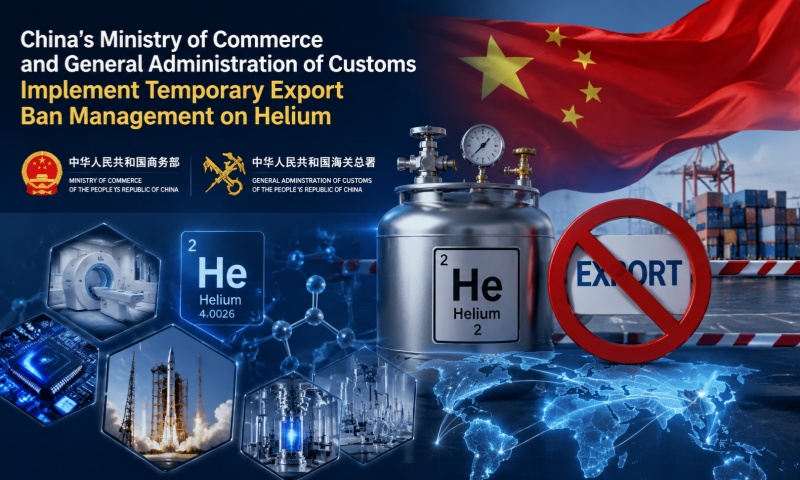
China’s Ministry of Commerce (MOFCOM) and the General Administration of Customs (GAC) have announced the implementation of temporary export prohibition management measures on helium, marking a significant development in the global helium supply chain. The new policy reflects the increasing strategic importance of helium resources and the growing emphasis on ensuring domestic supply security, industrial stability, and effective resource management.
Helium is a critical industrial gas with unique physical properties, including extremely low boiling point, chemical inertness, and high thermal conductivity. Due to these characteristics, helium plays an essential role in a wide range of high-technology industries, including semiconductor manufacturing, medical imaging, scientific research, aerospace, nuclear technology, superconducting systems, and analytical laboratory applications.
The temporary export management policy is expected to influence international helium trade patterns and encourage industries worldwide to pay closer attention to supply chain diversification, resource efficiency, and alternative gas management strategies.
Unlike many industrial gases, helium cannot be easily replaced in certain high-performance applications. Its unique properties make it indispensable in advanced scientific and industrial fields.
In the medical sector, helium is widely used for cooling superconducting magnets in magnetic resonance imaging (MRI) systems. In scientific research, helium is essential for low-temperature experiments, quantum research, and superconductivity studies. In semiconductor manufacturing, helium is used in cooling, plasma processes, and equipment operation.
Laboratories also rely on helium for analytical instruments such as gas chromatography (GC), where helium is commonly used as a carrier gas due to its stability and excellent performance characteristics.
The increasing demand for advanced technologies has accelerated global helium consumption. At the same time, helium resources are geographically concentrated, making supply security an important concern for many countries and industries.
According to the announcement by China’s Ministry of Commerce and the General Administration of Customs, helium will be subject to temporary export prohibition management. The measure is part of China’s broader approach to strengthening export management of strategic resources and maintaining orderly trade practices.
The implementation means that companies involved in helium-related international trade will need to comply with updated regulatory requirements. Export activities involving helium will face stricter management procedures, and businesses will need to review their supply chain arrangements to ensure compliance.
The policy demonstrates the importance of strategic resource management and reflects global trends toward tighter oversight of critical materials.
China’s helium export management decision may have implications for the global helium market, particularly for industries that depend on stable helium availability.
The international helium market has historically experienced supply fluctuations due to limited production sources, transportation challenges, and increasing demand from emerging technologies. Any change affecting helium supply channels may encourage companies to explore additional sourcing strategies and improve resource efficiency.
Industries that rely heavily on helium may consider several approaches, including:
Strengthening helium inventory management
Improving helium recovery and recycling systems
Developing alternative supply channels
Increasing investment in helium conservation technologies
For laboratory users, helium conservation has already become an important topic. Many laboratories are adopting advanced gas management systems, leak detection technologies, and alternative gas solutions where possible.
The helium export policy also highlights the importance of efficient laboratory gas management. Analytical laboratories, especially those using gas chromatography systems, have traditionally relied on helium as a carrier gas. However, increasing helium costs and supply uncertainty have encouraged laboratories to consider alternative approaches.
Hydrogen and nitrogen are becoming increasingly important alternatives in certain analytical applications. Modern laboratory gas generators provide reliable on-site gas production, helping laboratories reduce dependence on external gas cylinders and improve operational stability.
Companies specializing in laboratory gas solutions, including nitrogen generators, hydrogen generators, and zero air generators, are expected to play a growing role in supporting laboratories seeking more sustainable gas supply strategies.
Following the announcement of China’s temporary helium export management measures, international industries are expected to continue monitoring developments in helium supply and trade policies.
The global demand for helium is likely to remain strong due to continued growth in semiconductor production, medical technology, scientific research, and advanced manufacturing.
Experts believe that long-term helium supply security will require cooperation among governments, resource companies, technology providers, and industrial users. Improving helium recycling technology, expanding resource exploration, and developing efficient utilization methods will become increasingly important.
At the same time, companies may accelerate investment in alternative technologies to reduce reliance on limited natural resources.
China’s Ministry of Commerce and General Administration of Customs’ temporary export prohibition management on helium represents an important development in global industrial gas markets. As a strategic resource supporting advanced technology industries, helium plays a vital role in medicine, scientific research, semiconductor manufacturing, and analytical laboratories.
The new policy highlights the importance of resource security, supply chain resilience, and efficient utilization of critical materials. For industries worldwide, it serves as a reminder that stable access to essential resources requires long-term planning, technological innovation, and responsible resource management.
As global demand for high-tech applications continues to grow, helium will remain a strategically important resource. At the same time, advances in gas generation technology, recycling systems, and alternative solutions will provide new opportunities for industries seeking greater flexibility and sustainability in their gas supply strategies.