
Consultation Hotline
+1 (302) 618-8777
+1 (302) 618-8777
Current location:Home > Blogs > Industry News
San Diego, USA — July 2026
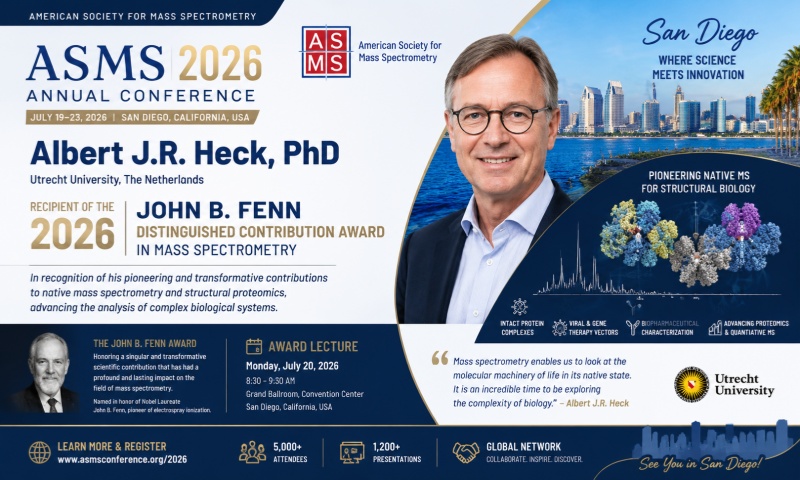
The American Society for Mass Spectrometry (ASMS) has announced that Professor Albert J.R. Heck of Utrecht University has been named the recipient of the 2026 John B. Fenn Distinguished Contribution Award in Mass Spectrometry, recognizing his groundbreaking and sustained contributions to the development and application of native mass spectrometry for the study of large biological macromolecular assemblies.
The award, named in honor of Nobel Laureate John B. Fenn—pioneer of electrospray ionization—celebrates a singular and transformative scientific achievement that has significantly advanced the field of mass spectrometry. Professor Heck’s work over the past two decades has redefined how researchers investigate the structure, function, and dynamics of protein complexes, viruses, and biomolecular assemblies.
The award ceremony took place during the ASMS 2026 Annual Conference in San Diego, where Professor Heck delivered the distinguished award lecture before an international audience of leading scientists in analytical chemistry, proteomics, and structural biology.
Professor Heck is widely recognized as one of the most influential figures in modern mass spectrometry. His research group at Utrecht University has played a central role in transforming native mass spectrometry (native MS) from a specialized analytical technique into a broadly used platform for structural biology.
Native MS allows intact biomolecular complexes to be transferred into the gas phase while preserving non-covalent interactions. This capability enables researchers to analyze the composition, stoichiometry, and architecture of protein assemblies with unprecedented clarity.
Heck’s pioneering contributions have enabled the application of native MS to increasingly complex systems, including large protein assemblies, viral capsids, antibody complexes, and adeno-associated viruses (AAVs). His work has provided key insights into how biomolecular machines assemble and function in their native environments.
By advancing both instrumentation and methodology, Heck has helped position mass spectrometry as a complementary and often indispensable tool alongside cryo-electron microscopy, X-ray crystallography, and other structural biology techniques.
A major hallmark of Heck’s research has been his ability to push the technical boundaries of mass spectrometry instrumentation. His group has collaborated with instrument developers to extend the mass range and sensitivity of modern mass analyzers, enabling the study of extremely large protein complexes that were previously inaccessible.
These innovations have not only improved analytical performance but have also opened entirely new fields of research. One notable example is mass spectrometry-based structural virology, where intact viral particles and their assemblies can now be examined with molecular precision.
In addition, Heck’s research has contributed significantly to the analysis of biopharmaceutical products. His methods are widely used in the characterization of monoclonal antibodies, gene therapy vectors, and other advanced biologics, where understanding higher-order structure is critical for safety and efficacy.
Beyond structural biology, Professor Heck has made foundational contributions to proteomics, particularly in the development of advanced analytical workflows that enhance sensitivity, specificity, and quantification.
His innovations include:
Development of phosphopeptide enrichment strategies, enabling improved detection of phosphorylation events in signaling pathways
Introduction of alternative protease digestion strategies, expanding sequence coverage in complex proteomes
Advancement of hybrid fragmentation methods, including electron-transfer/higher-energy collision dissociation (EThcD)
Creation of cost-efficient isotopic labeling approaches, such as dimethyl labeling for quantitative proteomics
Development of proteome-wide cross-linking mass spectrometry techniques, enabling spatial mapping of protein-protein interactions
These contributions have significantly shaped modern proteomics workflows, making high-throughput protein characterization more accessible and reproducible across laboratories worldwide.
The influence of Heck’s research extends far beyond analytical chemistry. His work has become integral to modern biomedical research, drug development, and biotechnology.
In pharmaceutical science, native MS is now widely used for:
Quality control of biologic therapeutics
Structural characterization of antibody-drug interactions
Stability assessment of viral vectors used in gene therapy
Investigation of protein aggregation and misfolding processes
Heck’s methodologies have helped establish mass spectrometry as a critical tool in regulatory science and biopharmaceutical manufacturing.
His contributions are particularly important in the rapidly growing field of gene therapy, where viral vector characterization requires highly precise structural information that traditional techniques alone cannot provide.
Professor Heck’s selection for the 2026 John B. Fenn Award adds to an already distinguished list of international honors. He is a recipient of numerous prestigious awards, including the Spinoza Prize, the Thomson Medal, and recognition from leading scientific societies in analytical chemistry and proteomics.
He is also a member of the European Molecular Biology Organization (EMBO) and the Royal Netherlands Academy of Arts and Sciences (KNAW), reflecting his broad influence across disciplines.
Over the years, his laboratory at Utrecht University has trained and mentored a large generation of scientists who now occupy leading positions in academia and industry. Many of these researchers have contributed directly to the expansion of native MS and proteomics technologies worldwide.
At the ASMS 2026 Annual Conference, the John B. Fenn Award lecture delivered by Professor Heck was one of the most anticipated scientific highlights of the meeting. The lecture drew a full audience, reflecting the global impact of his work.
In his remarks, Professor Heck emphasized that the award represents not only individual achievement but also the collective contributions of his research group and collaborators across academia and industry.
He highlighted the importance of long-term collaboration, technological innovation, and interdisciplinary integration in advancing modern mass spectrometry.
The John B. Fenn Distinguished Contribution Award is one of the most prestigious honors in mass spectrometry. Named after John B. Fenn, co-recipient of the 2002 Nobel Prize in Chemistry for the development of electrospray ionization, the award recognizes a focused and transformative scientific contribution that has had a lasting impact on the field.
Unlike lifetime achievement awards, the Fenn Award specifically honors a singular breakthrough or body of work that fundamentally advances analytical science.
Recipients are invited to present their work in a dedicated plenary lecture at the ASMS Annual Conference.
The 2026 award to Albert J.R. Heck underscores the continuing evolution of mass spectrometry as a central technology in modern life sciences. His pioneering work in native mass spectrometry, proteomics, and structural biology has reshaped how scientists understand macromolecular systems and has created powerful tools that bridge chemistry, biology, and medicine.
As the field continues to advance, Heck’s contributions remain foundational to the development of next-generation analytical methods that will further expand the limits of molecular science.