Consultation Hotline
+1 (302) 618-8777
+1 (302) 618-8777
Current location:Home > Blogs > Industry News
Advances in Artificial Intelligence Accelerate Drug Discovery, Development, and Manufacturing Across the Biopharmaceutical Industry
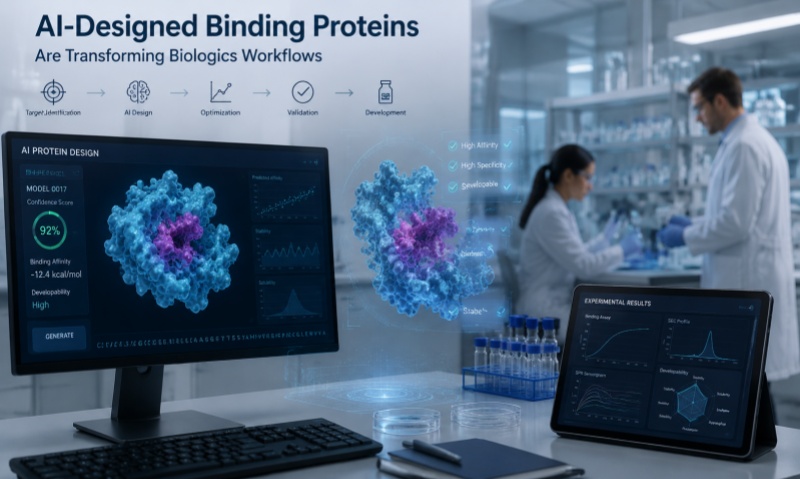
BOSTON, Mass. — May 2026 — Artificial intelligence is rapidly reshaping the future of biologics development, with AI-designed binding proteins emerging as one of the most promising innovations in modern biotechnology. By combining advanced machine learning algorithms with protein engineering, researchers are creating highly specific binding proteins faster than ever before, transforming workflows across drug discovery, therapeutic development, diagnostics, and biomanufacturing.
The ability to computationally design proteins that selectively bind to disease-related targets has long been a goal of the life sciences industry. Recent breakthroughs in generative AI, structural biology, and protein modeling have now made that vision a reality, enabling scientists to dramatically reduce development timelines while improving success rates.
Industry experts believe AI-designed binding proteins could fundamentally change how biologic medicines are discovered, optimized, and produced in the coming years.
Binding proteins play a critical role in biologics research and development. They are used to recognize and interact with specific molecular targets, including proteins, peptides, nucleic acids, and cell surface receptors. Traditional methods for discovering and optimizing these molecules often require extensive laboratory screening, iterative experimentation, and significant financial investment.
Artificial intelligence is helping overcome these limitations.
Modern AI models can analyze vast biological datasets, predict protein structures, identify binding sites, and generate entirely new protein sequences optimized for target interactions. Instead of screening millions of candidates in the laboratory, researchers can now use computational tools to design highly promising candidates before experimental validation begins.
This approach significantly accelerates the early stages of drug discovery and reduces the resources required for protein engineering projects.
Biopharmaceutical companies are increasingly adopting AI-driven protein design technologies to streamline therapeutic development programs.
AI-designed binding proteins can be engineered for a wide range of applications, including:
Therapeutic antibodies
Bispecific antibodies
Protein therapeutics
Targeted drug delivery systems
Cell and gene therapy platforms
Diagnostic reagents
Research tools
By identifying optimal binding characteristics early in development, AI enables researchers to generate candidates with improved affinity, specificity, stability, and manufacturability.
This capability is particularly valuable as drug developers pursue increasingly complex targets that have historically been difficult to address using conventional approaches.
“AI is allowing scientists to explore protein design spaces that were previously inaccessible,” said a biotechnology industry analyst. “What once took years of laboratory work can now be accomplished in months or even weeks.”
One of the most significant advantages of AI-designed binding proteins is their potential to improve precision while reducing development risk.
Traditional discovery methods often involve trial-and-error experimentation, leading to high attrition rates during preclinical and clinical development. AI models can predict potential liabilities earlier in the process, including issues related to stability, immunogenicity, and manufacturability.
As a result, researchers can prioritize stronger candidates and eliminate problematic molecules before costly downstream development activities begin.
This data-driven approach helps organizations make better decisions, allocate resources more effectively, and improve overall research productivity.
The benefits of AI-designed proteins extend beyond discovery and into biomanufacturing operations.
Manufacturing teams are leveraging computational design tools to optimize proteins for expression, purification, formulation, and long-term stability. Improved protein characteristics can simplify production workflows, increase yields, and reduce manufacturing costs.
In addition, AI-designed affinity reagents are being used to enhance purification processes and analytical testing methods, improving efficiency throughout the biologics production lifecycle.
As biopharmaceutical manufacturers seek greater operational flexibility, AI-driven protein engineering is becoming an important tool for achieving both technical and economic objectives.
The rise of precision medicine is creating demand for highly customized therapeutic solutions tailored to individual patient populations.
AI-designed binding proteins offer a powerful platform for developing personalized biologics capable of targeting specific disease mechanisms with exceptional accuracy. Researchers are exploring applications in oncology, autoimmune disorders, rare diseases, infectious diseases, and neurodegenerative conditions.
By rapidly generating proteins optimized for unique biological targets, AI technologies may help accelerate the development of next-generation precision therapies.
Many experts believe these capabilities will play a central role in the future of personalized healthcare.
While artificial intelligence is dramatically improving protein design capabilities, scientists emphasize that human expertise remains essential.
AI models generate predictions and design recommendations, but experimental validation continues to be critical for confirming biological performance and safety. Successful development programs combine computational innovation with laboratory science, structural biology, bioinformatics, and clinical expertise.
Rather than replacing researchers, AI is enhancing their ability to solve complex biological problems more efficiently.
This collaborative approach is helping organizations unlock new opportunities across the life sciences sector.
The adoption of AI-designed binding proteins is expected to accelerate as computational technologies continue to evolve. Improvements in machine learning models, structural prediction algorithms, and biological data availability are expanding the possibilities for protein engineering and biologics development.
Industry leaders anticipate that AI-driven design platforms will become a standard component of future drug discovery and development workflows.
As pharmaceutical and biotechnology companies seek faster innovation, lower development costs, and improved clinical outcomes, AI-designed binding proteins are emerging as a transformative technology capable of reshaping the entire biologics ecosystem.
From early-stage discovery to commercial manufacturing, artificial intelligence is enabling a new generation of biologic medicines—and helping bring life-changing therapies to patients more quickly than ever before.