Consultation Hotline
+1 (302) 618-8777
+1 (302) 618-8777
Current location:Home > Blogs > Industry News
For decades, developing a new biologic meant one thing: screening. Whether using phage display, yeast display, or immunized animals, researchers have relied on vast libraries of random or semi‑random sequences, hoping to pull out a rare binding hit. The process is powerful but painfully slow, expensive, and often fails against difficult targets—flat protein interfaces, ion channels, or highly conserved epitopes.
That era is ending. A new generation of AI‑driven protein design tools is shifting biologics workflows from discovery by screening to design by computation. Using generative models such as RFdiffusion, ProteinMPNN, and Chroma, researchers can now create de novo binding proteins tailored to virtually any target—without natural scaffolds, without animal immunization, and without massive experimental libraries.
In a traditional biologics workflow, identifying a lead binder typically requires three to six months. This includes library construction, multiple rounds of panning, deep sequencing, and extensive hit validation. For challenging targets, the timeline can stretch to a year or more, with no guarantee of success.
AI‑designed binding proteins collapse that timeline. Leading academic groups—most notably the Institute for Protein Design (IPD) at the University of Washington—and biotech startups like Vilya, Archon Biosciences, and Generate:Biomedicines have demonstrated that generative models can produce high‑affinity binders in silico within hours. Experimental validation, including gene synthesis, expression, and binding assays, adds only one to two weeks.
In several recent case studies, first‑round designs achieved nanomolar or even sub‑nanomolar affinity without any affinity maturation. For targets such as the SARS‑CoV‑2 spike protein receptor‑binding domain (RBD), IGF‑1R, and the cancer‑associated integrin αVβ3, AI‑generated mini‑proteins matched or exceeded the affinity of antibodies developed over months of optimization—in a single design cycle.
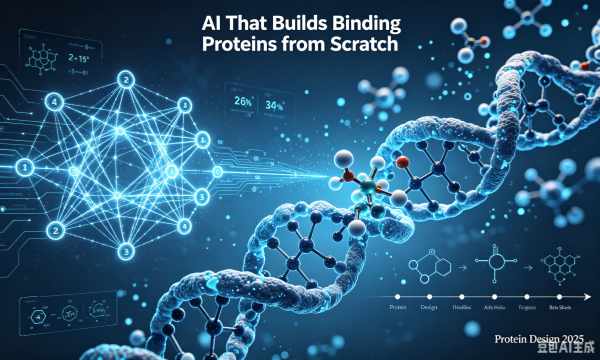
One of the most transformative aspects of AI‑designed binders is freedom from natural protein frameworks. Traditional biologics rely heavily on antibodies, nanobodies, or DARPins—all of which have structural constraints and potential immunogenicity liabilities.
Generative design produces entirely synthetic binding proteins, often less than 80 amino acids in length. These miniature binders offer several workflow advantages:
Thermostability by design. Unlike antibodies that often require humanization and stability engineering, AI‑generated proteins can be designed with melting temperatures exceeding 70 °C from the start.
Low inherent immunogenicity. De novo proteins lack natural sequence motifs recognized by human T‑cells, reducing the risk of anti‑drug antibodies (ADAs).
Precise epitope targeting. Designers can specify which surface patch of a target protein to bind, enabling functional modulation (agonism, antagonism, or targeted delivery) rather than mere recognition.
Manufacturing efficiency. Mini‑binders can be produced in E. coli or via chemical synthesis, eliminating the cost and complexity of mammalian cell culture.
Consider the work published in early 2026 by a collaborative team from IPD and the University of Toronto. Their target: the KRAS(G12D) mutant, a notoriously challenging driver of pancreatic cancer. Flat surfaces, lack of deep pockets, and high conformational flexibility have defeated multiple small‑molecule and biologic campaigns.
Using RFdiffusion with explicit negative design against the wild‑type KRAS, the team generated 2,000 candidate binders in a single computational run. Of the 88 designs tested experimentally, 31 showed measurable binding, and 9 exhibited low‑nanomolar affinity with specificity for the mutant over wild‑type. The lead molecule—just 68 amino acids—blocked SOS1‑mediated nucleotide exchange in vitro and showed on‑target activity in cell‑based assays.
Total time from target selection to functional validation: 19 days.
AI‑designed binders are not merely an incremental improvement. They are forcing a fundamental rethinking of biologic development pipelines.
1. Hit identification is no longer a bottleneck.
The limiting factor is no longer library diversity or panning rounds. It is the speed of computational sampling and the turnaround time for gene synthesis. Future workflows will generate hundreds of distinct primary hits computationally, test them in parallel, and advance the best designs directly to lead optimization—skipping the "hit to lead" phase entirely.
2. Optimization becomes predictive, not random.
Affinity maturation, traditionally achieved via error‑prone PCR or targeted mutagenesis libraries, is replaced by targeted in‑silico design. Models can propose point mutations or local motif swaps that are predicted to improve binding, solubility, or stability, dramatically reducing the number of variants that need to be produced and tested.
3. Developability is built in, not engineered later.
Aggregation, poor expression, and polyspecificity can be designed against from the outset. Multi‑objective optimization in models like ProteinMPNN allows researchers to specify a binding target while simultaneously optimizing for E. coli expression yield, high thermal stability, and absence of hydrophobic patches—all in the same sequence generation step.
It is important to clarify what AI does not do. Computational design is not yet perfect. Predicted structures have residual errors; binding affinities computed in silico often deviate from experimental measurements by an order of magnitude or more. False positives are common, and some targets remain recalcitrant.
Experimental validation—gene synthesis, protein expression, purification, binding assays (SPR, BLI, or ELISA), and functional testing—remains essential. However, the role of the laboratory shifts from discovery (screening huge libraries) to validation (testing a focused set of high‑confidence designs). That shift reduces reagent costs, accelerates cycles, and allows small teams to pursue targets previously accessible only to large‑scale industrial screening efforts.
Looking forward, the integration of AI design with high‑throughput validation and automated robotic platforms points toward a fully closed‑loop biologics workflow. Several contract research organizations (CROs) and tech‑bio companies are already offering "design‑synthesize‑test" services with turnaround times under 14 days.
Democratization is also on the horizon. As open‑source models (RFdiffusion, ProteinMPNN, ESMFold) and cloud‑based compute become widely available, even academic labs with limited resources can design custom binders against their targets of interest—without access to large phage display libraries or mammalian display infrastructure.
AI‑designed binding proteins represent a genuine paradigm shift for biologics development. The workflow is no longer constrained by the randomness of screening or the limitations of natural protein scaffolds. Instead, researchers can specify a target, design a binder, and move to validation with unprecedented speed and precision.
The question is no longer whether AI will transform biologics workflows. It is already happening. The remaining question is how quickly the industry will fully embrace design‑first biology—and which companies will be left behind.