Agilent gas chromatographs (GC) are widely applied in pharmaceutical analysis, environmental monitoring, food detection and chemical research, featuring high precision and stable analytical performance. The split line, detector and syringe are core vulnerable components that directly affect peak shape symmetry, baseline stability, repeatability and detection accuracy. Contaminants such as residual samples, heavy impurities, carbon deposits and high-boiling substances frequently accumulate in these parts during long-term continuous operation, leading to typical faults including baseline drift, miscellaneous peaks, tailing peaks, reduced sensitivity and poor separation effect. Regular and standardized cleaning maintenance is essential to eliminate cross-contamination, reduce instrument failure rate and extend the service life of Agilent GC equipment. This document systematically introduces the standardized cleaning specifications and operational precautions for Agilent GC split line, detector and syringe, providing reliable guidance for daily laboratory maintenance.
The split line is a key channel for gas diversion and impurity filtration in the split injection system, responsible for discharging excess sample gas and maintaining stable split ratio. It is extremely prone to accumulation of high-boiling residues, carbon deposits and particulate impurities, which will block the pipeline, cause unstable gas flow and distort peak shape if not cleaned in time. Before cleaning, turn off the GC heating system, cool down the injection port and oven to room temperature, and cut off the carrier gas and auxiliary gas supply to ensure operational safety. Disassemble the split pipeline filter, liner filter and connecting pipeline in sequence according to Agilent official maintenance standards. For slightly polluted pipelines and filter components, use chromatographic pure methanol, ethanol or n-hexane for repeated flushing to dissolve residual organic impurities. For moderate and severe carbon deposition and dirt accumulation, ultrasonic cleaning with low-power frequency is recommended for 2 to 3 minutes to completely strip stubborn attachments inside the pipeline.
After cleaning, place all disassembled parts in a dust-free and dry environment for natural air drying, and strictly prohibit high-temperature baking to avoid pipeline deformation and filter element damage caused by thermal stress. Before reassembly, inspect the pipeline for residual dirt and blockage, and confirm the filter element is clean and intact. After installation, conduct carrier gas purging for 10 to 15 minutes to remove residual cleaning solvent and air impurities in the pipeline, then perform baseline calibration. It is specified that the split line and filter assembly should be thoroughly cleaned every 200 to 300 sample injections, and the cleaning cycle should be shortened appropriately when detecting high-viscosity, high-boiling and complex matrix samples such as traditional Chinese medicine extracts and biological fluids.
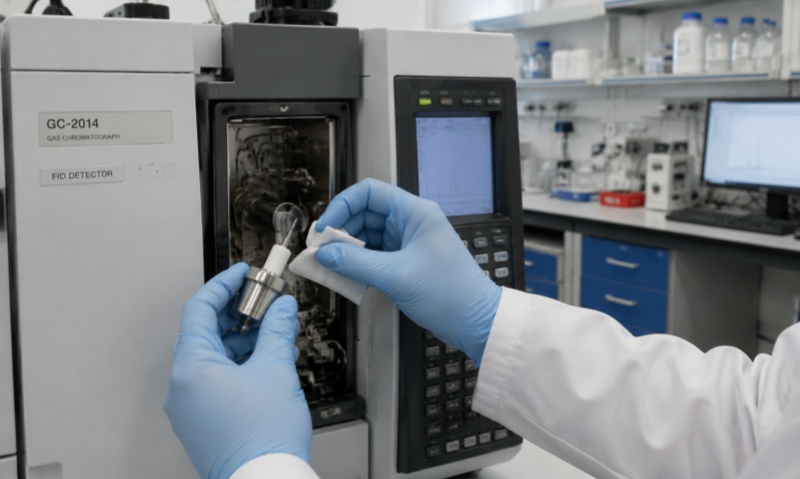
The detector, taking the commonly used Agilent FID detector as an example, is the core component for sample signal acquisition. Long-term operation will produce carbon deposits, combustion residues and silica contamination at the nozzle, collector pole and gas path, resulting in decreased detection sensitivity, fluctuating baseline and increased noise. The detector cleaning must be carried out after complete cooling and gas cut-off to prevent scalding and gas circuit failure. First, disassemble the detector hood, flame nozzle and collector electrode assembly carefully. Wipe the nozzle surface and electrode gap gently with dust-free cotton dipped in chromatographic pure methanol to remove surface carbon deposits and residual combustion products. For tiny nozzle holes with blockage, use a special fine needle for dredging, and avoid excessive force to prevent nozzle aperture deformation which affects flame stability.
After local wiping and dredging, assemble the components and turn on the auxiliary gas system for high-temperature baking and purging. Set the detector temperature to 350 ℃ and maintain baking for 30 minutes with stable hydrogen and air flow, which can effectively volatilize residual trace impurities in the gas path. After baking, cool down the detector naturally and conduct ignition test and baseline stability inspection. If the baseline is still unstable or the noise value is too high, disassemble the components again for deep cleaning and replace severely aged and polluted accessories in time. Regular detector cleaning can effectively ensure the linearity and sensitivity of the detection system and avoid systematic errors in quantitative analysis results.
The GC syringe is a precision sampling tool for quantitative injection, and its cleaning effect directly determines whether there is cross-contamination between samples and the accuracy of injection volume. Agilent supporting micro syringes have thin and delicate needle rods, which are easy to retain trace samples and high-boiling impurities in the needle tube and needle tip gap. Daily conventional cleaning is applicable to conventional low-viscosity organic samples. After each injection, discard the residual sample in the syringe completely, and repeatedly extract and push out chromatographic pure solvent for 3 to 5 times. Select matched cleaning solvents according to sample properties: use methanol or ethanol for water-soluble samples, and n-hexane or acetone for fat-soluble organic samples to ensure polar matching and thorough elution of residual components.
For complex matrix samples with high viscosity, easy crystallization and high boiling point, deep gradient cleaning is required to avoid stubborn residue. Firstly, use pure solvent to dilute and flush the residual samples in the needle tube, then perform ultrasonic cleaning for 1 to 2 minutes with low power. It is forbidden to use high-power and long-time ultrasonic cleaning to prevent needle rod deformation and needle tip damage. After cleaning, absorb the residual solvent at the needle tip with dust-free filter paper and place it flat for natural air drying. In addition, it is necessary to strengthen the interval cleaning during batch sample detection. Thoroughly clean the syringe with transitional solvent between high-concentration and low-concentration samples to eliminate cross-contamination caused by trace residue of high-concentration samples.
In the whole cleaning and maintenance process, standardized operational specifications must be strictly followed to avoid secondary damage and secondary pollution. All cleaning solvents must be chromatographically pure grade to prevent solvent impurities from polluting components. Disassembly and assembly operations should be gentle and accurate to avoid thread slipping, component extrusion and pipeline distortion. After all cleaning work is completed, conduct instrument stability test and blank baseline inspection. Only when the baseline is flat and no miscellaneous peaks appear can the formal sample analysis be carried out. Establish a regular maintenance ledger, record the cleaning time, cleaning items and component replacement status, and form a standardized maintenance mechanism.
In conclusion, the split line, detector and syringe are key pollution-prone components of Agilent gas chromatograph. Scientific and standardized cleaning maintenance can effectively solve common problems such as baseline drift, miscellaneous peak interference and poor repeatability caused by residual pollutants. Standardizing daily cleaning procedures and regular deep maintenance can not only ensure the accuracy and stability of GC detection data, but also reduce component loss and instrument failure frequency, greatly extend the comprehensive service life of the instrument, and provide a solid guarantee for long-term and efficient laboratory analytical work.