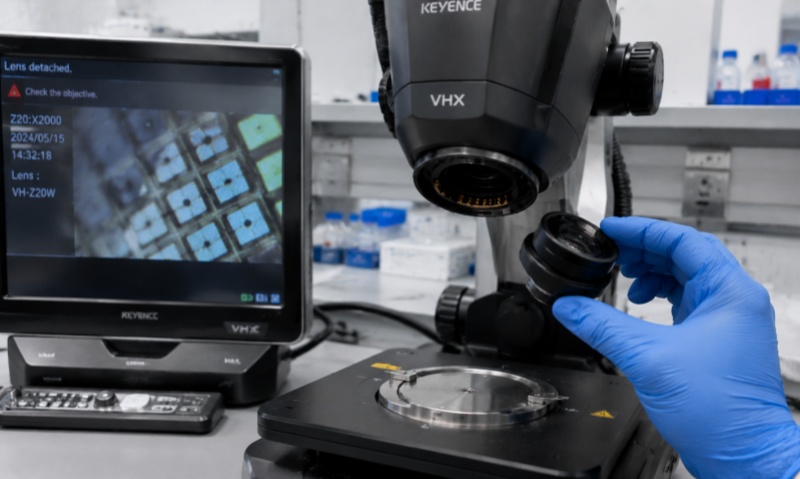
Metallurgical microscopes are essential precision optical instruments in material science laboratories, industrial quality inspection, and metallurgical research. Unlike biological microscopes, they are specially designed for observing opaque metal materials, alloy structures, and industrial solid samples. With high-resolution optical systems and professional illumination modules, these microscopes can clearly display the microscopic morphology, grain structure, phase distribution, and surface defects of metal samples. They play an irreplaceable role in material composition analysis, mechanical performance evaluation, product quality control, and failure mechanism research. To ensure long-term stable imaging accuracy and extend equipment service life, standardized daily cleaning and scientific maintenance are indispensable basic operations for laboratory staff.
The core function of a metallurgical microscope is high-precision microscopic observation and structural analysis of metallic and non-metallic opaque materials. In industrial production and scientific research, it is widely used to detect metal grain size, analyze material phase composition, and identify structural defects such as cracks, inclusions, and porosity. By observing the microstructure of materials, researchers can judge the rationality of metal heat treatment, casting, and forging processes, and verify whether material properties meet industrial standards. In addition, metallurgical microscopes can assist in failure analysis of mechanical parts, effectively tracing the root causes of component fracture, wear and corrosion from a microscopic perspective, providing reliable data support for process optimization and quality improvement.
In addition to basic structural observation, modern metallurgical microscopes are equipped with digital imaging systems and analysis software, realizing intelligent detection functions such as image acquisition, data measurement, and automatic report generation. They can accurately measure grain diameter, layer thickness, defect area and other key parameters, greatly improving the efficiency and accuracy of laboratory testing. As high-precision optical equipment, the imaging quality of metallurgical microscopes is extremely sensitive to dust, stains, fingerprints and oil contamination. Any tiny dirt on lenses, objective lenses and stage surfaces will cause blurred images, reduced contrast and inaccurate measurement results, making daily standardized cleaning particularly critical.
Standard cleaning of metallurgical microscopes is divided into optical component cleaning, mechanical structure cleaning and external surface cleaning, with strict operational specifications to avoid secondary damage. The optical lens is the most precise and vulnerable part. Dust on the lens surface should first be removed with a professional rubber blower or soft dust brush to prevent hard particulate dirt from scratching the coating during wiping. For fingerprints, oil stains and water marks that are difficult to remove, use lens cleaning paper dipped in a small amount of special optical cleaning solution, and wipe gently in a single direction. It is forbidden to use ordinary tissue, cotton cloth or alcohol with excessive concentration to avoid damaging the anti-reflection coating of the lens.
The objective lens, eyepiece and condenser need regular targeted cleaning according to usage frequency. As the core imaging component, the objective lens is prone to sample residue and oil contamination during detection. After each use, slight dirt should be cleaned in time, and thorough deep cleaning should be carried out every one to two weeks. The stage and pressing fixtures, which are in direct contact with metal samples, are easily stained with metal chips, polishing powder and oil. They can be wiped with a soft lint-free cloth dipped in a small amount of neutral cleaning agent, and dried completely after cleaning to prevent residual moisture from causing metal rust and component corrosion.
For the internal mechanical structure and lighting system, non-dismantling cleaning is the basic principle. Dust accumulated in the light hole and mechanical gap can be removed with a cold air blower. Avoid liquid cleaning solution penetrating into the internal circuit and transmission structure, so as to prevent short circuit failure and mechanical jamming. After cleaning, adjust the focal length and light source to check whether the imaging is uniform and clear, ensuring no residual stains affect the detection effect. Meanwhile, laboratory staff should develop good usage habits, cover the equipment with a dust cover after daily use, and place it in a dry, dust-free and stable environment to reduce contamination probability.
In conclusion, metallurgical microscopes are core equipment for material microscopic analysis and industrial quality inspection, with powerful functions supporting material research and industrial production optimization. Scientific and standardized cleaning maintenance is the key to maintaining stable equipment performance and accurate detection data. By implementing graded cleaning of optical and mechanical components, adhering to standardized operating procedures, and matching with daily dust prevention management, laboratories can effectively avoid imaging defects caused by contamination, reduce equipment failure rates, prolong the service life of precision instruments, and provide stable and reliable technical guarantee for daily material testing and scientific research work.