Laboratory ultrapure water systems are core essential equipment for ensuring qualified water quality and accurate experimental data in scenarios such as analytical testing, precision experiments, biopharmaceuticals, and environmental monitoring. During long-term operation, scale deposition frequently occurs on pipelines, reverse osmosis membranes, filter elements, and inner walls of water tanks. Scale can not only block water passages, reduce water production efficiency and increase operating energy consumption, but also breed microorganisms and release impurity ions, contaminating ultrapure water. This will cause key indicators including resistivity and TOC to fail to meet standards, seriously affecting the accuracy and repeatability of precision experiments. Therefore, mastering scientific anti-scaling technologies and operation and maintenance methods is a key measure to ensure the stable operation, extend the service life, and guarantee stable water supply quality of ultrapure water systems. Combining with the working principle of ultrapure water equipment, this paper systematically expounds the causes of scale formation and provides comprehensive and practical anti-scaling technical solutions.
The core causes of scale formation in laboratory ultrapure water systems mainly fall into two categories: raw water impurities and equipment operating conditions. Tap water, groundwater and other raw water generally contain hardness ions such as calcium, magnesium and bicarbonate, as well as soluble salts, which are the fundamental substances for scale formation. During the water production process of ultrapure water systems, the continuous concentration of raw water increases the salinity of water. When the solution reaches a saturated state, insoluble substances such as calcium carbonate and magnesium carbonate precipitate and crystallize, adhering to the water passages and membrane surfaces of the equipment. In addition, long-term continuous operation, excessive water temperature, low flow velocity and unreasonable wastewater ratio will accelerate salt concentration and crystallization. Long-term shutdown and standing without timely flushing will cause impurities to deposit and solidify, forming hard scale that is difficult to remove.
Effective pretreatment is the primary barrier to fundamentally prevent scale formation in ultrapure water systems. Most scaling problems of laboratory ultrapure water equipment are directly caused by inadequate pretreatment. First, it is necessary to select suitable pretreatment filter elements according to raw water quality and regularly replace PP cotton, activated carbon and softening filter elements to intercept sediment, suspended solids and colloidal impurities and reduce raw water hardness. For areas with high-hardness raw water, a special water softener must be installed to replace calcium and magnesium ions through ion exchange technology, fundamentally reducing the source of scale formation. Second, a scale inhibition device can be configured in the pretreatment system with food-grade special scale inhibitors. Through chelation and dispersion effects, the agents prevent salt crystallization and destroy the formation structure of scale, effectively avoiding scaling on membrane elements and pipelines.
Standardizing daily operating parameters can effectively delay scale deposition. During equipment operation, the water temperature must be strictly controlled. The optimal operating temperature of ultrapure water systems is 15-25°C. Excessively high temperature accelerates the decomposition of bicarbonate and speeds up scale precipitation, so heat dissipation and ventilation should be guaranteed in high-temperature seasons. Meanwhile, the ratio of pure water to wastewater should be reasonably adjusted to avoid excessive concentration of raw water. Under conventional working conditions, the wastewater ratio should not be lower than 1:3, and the wastewater discharge ratio can be appropriately increased for high-hardness water to reduce the salinity of concentrated water. In addition, long-term idle shutdown of the equipment should be avoided. If the equipment is shut down for more than 24 hours, the automatic flushing mode shall be activated to flush concentrated water in pipelines and membrane elements and prevent impurity deposition and solidification.
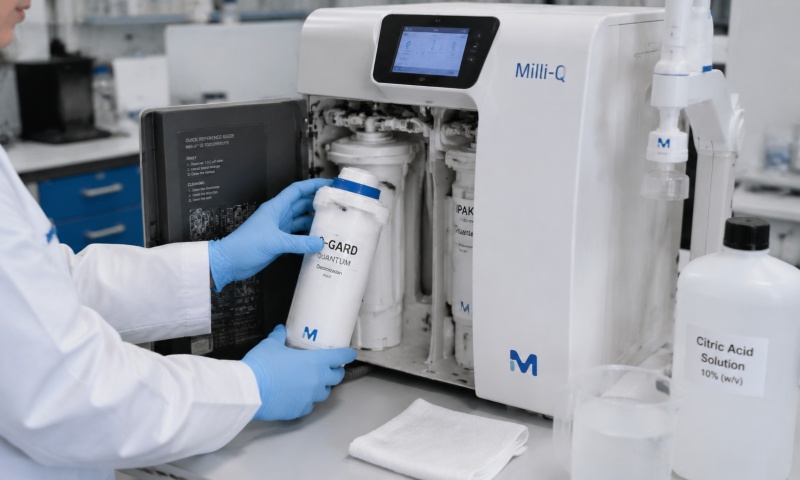
Standardized regular maintenance and cleaning are core means to eliminate potential scaling hazards and ensure long-term stable operation of equipment. Operators shall establish a regular operation and maintenance ledger. Conduct simple flushing on water inlets, pipelines and pressure barrels every week to remove loose surface sediments. Check the operating status of reverse osmosis membranes and nanofiltration membranes monthly and observe pressure difference changes. Low-pressure flushing shall be carried out timely if pressure difference rises or water yield decreases. Conduct professional chemical cleaning every 3 to 6 months with suitable acidic cleaning agents to gently dissolve scale crystals on membrane surfaces and inner pipeline walls, avoiding corrosion of equipment components by strong acid. Meanwhile, regularly clean the sterile ultrapure water tank and wipe off attachments on the inner wall to prevent impurity accumulation, scaling and microbial growth.
In addition, establishing a regular water quality monitoring mechanism can realize early warning of potential scaling risks. Key operating data including ultrapure water resistivity, water production flow and inlet and outlet pressure difference shall be monitored daily. Decreased flow, increased pressure difference and fluctuating water quality are typical early signs of scaling, which require timely troubleshooting and treatment. Meanwhile, regularly detect raw water hardness and TDS value, and adjust pretreatment schemes and maintenance frequency according to water quality changes to realize advanced prevention and targeted control.
In summary, the prevention and control of scale formation in laboratory ultrapure water systems follows the full-process principle of "source prevention, process control, regular maintenance and dynamic monitoring". By optimizing the pretreatment system, standardizing operating conditions, implementing regular cleaning and maintenance, and carrying out normalized water quality monitoring, the formation and deposition of scale can be maximally avoided. This ensures the efficient and stable operation of ultrapure water systems, continuously produces qualified ultrapure water, builds a solid water quality foundation for various precision laboratory experiments, reduces equipment failure rates effectively, extends equipment service life and cuts operation and maintenance costs.